The topic of “Moving to Dubai” is currently on everyone's lips. But why should you emigrate, what is the process like and what costs should I generally expect?
In this comprehensive guide, we answer all the important questions about emigrating to Dubai. Starting with the advantages and disadvantages, requirements and procedures, through to costs and personal experiences from the local area.
- The reasons for emigrating to Dubai include low taxes, high security, excellent (business) infrastructure, and educational opportunities for families with children.
- The residence permit obtained through a job (employer), investment (e.g., real estate purchase), or business setup. The latter is the most popular route for entrepreneurs in Dubai.
- The complete process Emigration via company formation usually takes 2 weeks, of which you only need to be physically present in Dubai for 2 to 3 days.
- The cost of living for Dubai are higher than in Europe. Our recommendation is a monthly income of €5,000 for singles or €7,500 for couples or families
- Upon moving away You should watch out for potential taxes from your home country, such as exit tax or similar, and discuss them with your tax advisor.
Tax residence, exit taxes and pensions work differently in every country. Our country guides cover what you need to sort out before you leave:
Why move to Dubai?
The central question many ask themselves at the beginning is: Why do so many people emigrate to Dubai, and does Dubai make sense for me too? This question is crucial, so here are the most important pros and cons presented side-by-side. Of course, one should always weigh these individually. For some, certain aspects will carry more weight than others. For example, someone emigrating with their family will have different requirements than someone emigrating alone at a young age.
Advantages
The advantages of emigration are many and the list is long. Here are the most important aspects that speak in favor of emigrating to Dubai.
Taxes
The most obvious advantage is definitely the Taxes in Dubai. Especially when compared directly to Austria, Germany, or other European countries with tax rates exceeding 50 %. Dubai and the UAE offer an exceptionally attractive tax system for a wide range of people in various professions.
In principle, there is no income tax at private level. This means that income from work/profession is not taxed and there are no social security contributions. Gross is therefore equal to net.
This also applies to capital gains from shares, crypto, foreign exchange and more. Active income from trading these assets is also not taxed. Dividend distributions are also not taxed.
Furthermore, there are no taxes on income from rental income. Conventional letting of owner-occupied properties is not classified as commercial and is therefore tax-free. The exception is short-term rentals through Airbnb and Booking.com, from 7 residential units. A company must be founded and a license obtained for this.
Companies also pay no or very little tax in the UAE. Up to a turnover of AED 3,000,000, there is a tax exemption through the so-called Small Business Relief. In addition, you must pay 9 % in corporate income tax, but you still have a tax-free allowance of approximately 100,000 USD. However, your salary remains tax-free and can reduce your potentially taxable income.
Thus, depending on the size of the company, you either pay no taxes or a maximum of 9 % on corporate profits.
Safety
Another important point in favor of emigrating to Dubai is the high level of safety. Here too, a comparison to Europe must be made, as safety has been declining sharply for years in many countries, especially large cities like London, Paris, Madrid, and Berlin.

In contrast to this Dubai is currently one of the safest cities in the world. Globally, in the top 10 safest cities, 5 are from the Emirates. The country prioritizes safety, and you can feel it as a resident. Minor offenses such as theft, burglary, or assault hardly occur.
In practice, you can go for a walk at night without any problems, even as a woman, and wear a luxury watch. Children are also particularly safe in Dubai and can travel to and from school alone from a young age. This is a decisive point, especially for families.
The numerous, exaggerated social media experiments where valuable items are deliberately placed in public places and left unattended for hours can be believed. Whether it's a watch, cash, or an expensive handbag, if you forget something, you can be sure you'll get it back.
Infrastructure
Dubai is one of the most modern cities in the world and the infrastructure is extremely good in many areas. The umbrella term infrastructure can be divided into sub-areas, so here is an overview of the most important points:
Hospitals Dubai has some of the most modern hospitals in the world with internationally trained staff and excellent doctors. From the American Hospital to Saudi German Hospital to King’s College Hospital, you can find internationally renowned clinics. In addition to conventional medical care, Dubai also offers numerous alternative medicine treatments and preventative options. Regenerative medicine, for example, is offered by the DNA Clinic or AEON Clinic offered.

Schools Another factor that attracts many parents and families to Dubai is the excellent schools. There is a large selection of TOP Schools in Dubai, which are both German-language and international or multilingual. From kindergarten to elementary school to secondary school, there is a wide range of multilingual options with internationally recognized qualifications. Some of the best schools include the German International School and the Swiss International Scientific School. As more and more families emigrate to Dubai, this is a decisive factor.
Sports facilities A key issue for many expats and expatriates in terms of quality of life is sport. Here too, Dubai offers a comprehensive infrastructure with modern sports facilities of all kinds. The following sports in particular are strongly supported and offer many facilities:
- Gym
- Martial arts
- Padel
- Tennis
- Golf
- Yoga
- Pilates
Restaurants The world's best restaurants have also been found in Dubai for many years. These include excellent establishments such as ZUMA, Nammos, Gaia, Robertos, Nobu, or other hotspots. Those who love high-quality food and high-end dining will definitely get their money's worth here. In addition, there are numerous cafes in Dubai for all bean lovers and those who enjoy brunching.
Airport One of the strongest aspects of Dubai's infrastructure is the airport DXB. The home airport of the world-class airline Emirates offers direct flights to almost all destinations in the world. Whether to Europe, Asia, or America, you can get direct flights to nearly all major cities, sometimes even several times a day. Abu Dhabi Airport is also only 1.5 hours from Dubai and offers further connections around the world.
Residence visa
One point that is often taken for granted is visa options and processing speed. While other countries have extremely restrictive visa procedures that exclude a great many people from the outset, almost anyone can get a visa in Dubai.
Regardless of your origin, you only have to provide for your income through a job or self-employment (company formation in Dubai) and you get a residence visa, which can be renewed after two years. Not only are the requirements relatively simple and accessible to many, but so is the implementation. Most visa applications take from company formation, through entry with a medical test and biometrics, to Emirates ID only a few days. In most cases, the entire process is completed in less than 2 weeks.
In addition, you also have the option of Golden VISA through the purchase of real estate (e.g Buying an apartment in Dubai) with a value of over AED 2,000,000 or if you have a special profession such as a doctor or similar.
Banking system
An often underestimated factor when emigrating is the banking system. If you want to live in Dubai, you will of course need a bank account with both local and international currency support. Compared to many other emigration destinations such as Cyprus, where you cannot use the local banks, Dubai offers an excellent banking system.
Banks, such as Mashreq or FAB, in Dubai are among the safest in the world and are also state-backed or supported. The local currency is pegged to the USD and is therefore very stable.
Opening a bank account in Dubai for expats is also comparatively easy, as long as you keep a few basic things in mind. There are also great commercial banks for entrepreneurs that support international businesses.
Disadvantages
No country or city is perfect. Dubai is one of them and there are few Disadvantages in Dubai, which one should be aware of before emigrating. These should, of course, also be weighed subjectively, and some may find them worse than others. Here is an overview of the biggest “cons” of Dubai.
Hot summers
As pleasantly warm and sunny as winter and the transitional months are, it is unfortunately much hotter in Summer in Dubai. Temperatures reach over 40 degrees Celsius from May to September and rarely drop below 30 degrees Celsius at night. Thus, the summer is very hot, and life mostly takes place indoors.

For many, it's not a problem, as these months are very good for taking a vacation or traveling for a longer period. However, if you decide to stay in Dubai, you have to structure your life so that most activities take place indoors.
Traffic
Due to Dubai's high popularity, both with tourists and expats, the city has become increasingly crowded in recent years. This is reflected not only in rising prices but also in traffic. During rush hour, the main arteries are completely overwhelmed, and traffic jams regularly occur.
If you don't have a typical 9-5 job, you can escape this somewhat, although traffic-wise, except for Sundays, Dubai rarely gets quiet.
Requirements
When emigrating to Dubai, the requirements are very low compared to other countries. You simply need to bring enough money to sponsor your own visa through company formation or property purchase and then pass the medical test. As long as you don't have any sexually transmitted diseases or poliomyelitis, this also won't be a problem.
Otherwise, there are no restrictions on countries or certain groups of people. Anyone who adheres to the laws is welcome. However, those who do not will also be quite quickly rejected or deported. Dubai does not tolerate troublemakers or criminals.
But you also have to be able to afford to continue living, because the Cost of living in Dubai are definitely higher than in many European cities. If you can't afford it, you definitely shouldn't emigrate. If you earn less than €5,000 per month, you probably won't be happy in this city. Ideally, you should earn €6,000 - €7,000 upwards, as you have to pay for everything privately. However, if you earn well, you will save a lot of money in Dubai, as there are no taxes on income.
Process: How to Move to Dubai?
The emigration process can be divided into several sections. The following is a brief step-by-step guide to emigrating to Dubai.
1. Deregistration
Deregistration at the registration office is the simplest part of moving away - and also the most frequently misunderstood. This is because formal re-registration alone is not enough to actually end tax residency in Germany, Austria or Switzerland. The decisive factor in all three countries is not where you are registered, but where the Actual center of life interests is located.
The tax office examines a variety of factors: Anyone who still has their own home, a vehicle registered in their name, active health insurance, ongoing association or club memberships, an active tax advisor or close family ties in their country of origin runs the risk of continuing to be classified as a tax resident - despite formal deregistration.
Proper deregistration therefore includes the complete termination of all links: Rental contract or transfer of ownership of the apartment, termination of health, liability and life insurance, deregistration of the vehicle, termination of club memberships, termination of standing orders as well as the formal deregistration at the responsible Tax office with written confirmation of the departure for tax purposes.
In Germany it is also advisable to obtain a so-called Certificate of exemption at the tax office confirming that no further tax claims exist.
In Austria the tax office must be actively informed of the departure and a final tax return must be submitted for the year of departure - the so-called short financial year.
In the Switzerland the process varies from canton to canton, but in principle it is mandatory to deregister with the commune and the cantonal tax office, together with a final tax assessment for the year of departure.
Ultimately, different countries have different laws regarding deregistration, and one should clarify this individually for their own situation.
Another point that is often forgotten: anyone who regularly spends longer periods in their country of origin after deregistration - the rule of thumb is more than 183 days per year - risks being reclassified as a tax resident. The days spent in the country of origin should therefore be consistently documented and kept as clearly as possible below this threshold. In short: a clean deregistration is not a bureaucratic act, but a strategic measure that ideally 6 to 12 months before the planned departure should be planned with a specialized tax advisor.
2. health insurance
The next point is the conclusion of a new Health insurance. Taking out insurance is also a legal requirement in Dubai. You must be insured on site at the latest. There are basically two options to choose from: international health insurance or local health insurance.
If you travel a lot and are not only in Dubai all year round, you should think about international health insurance. This not only protects you in the UAE, but also in other parts of the world and covers costs in the event of illness (depending on the tariff/package). Popular providers include Passport Card, April and Foyer.
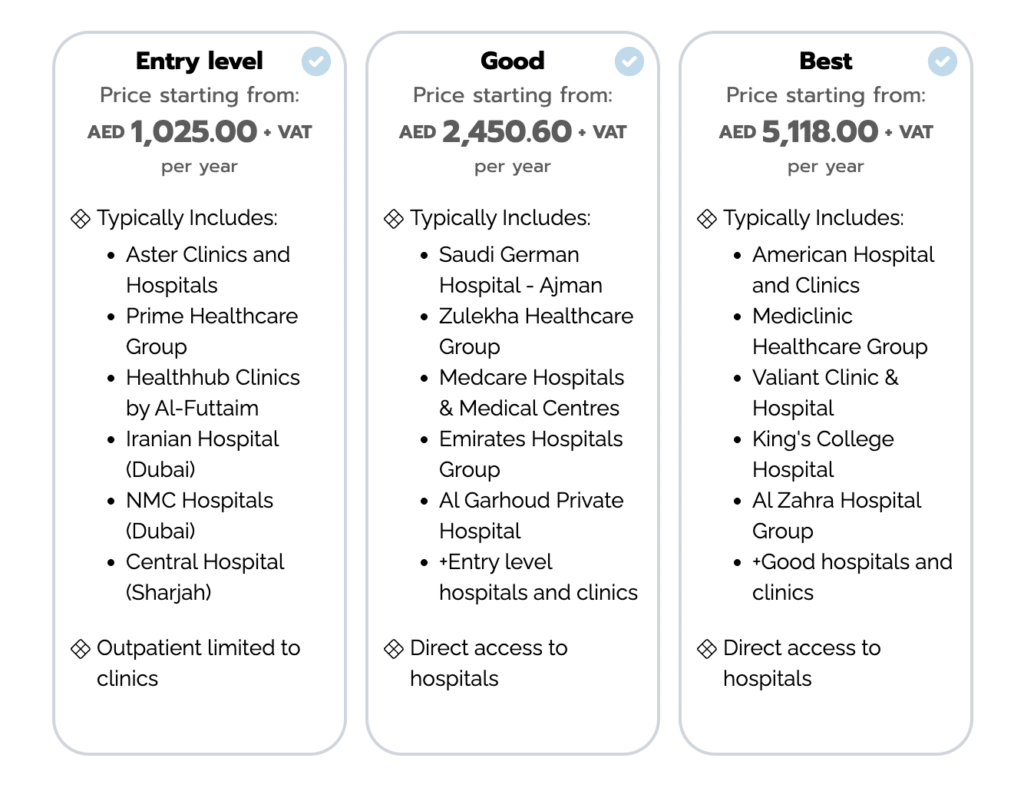
However, there are also cheap local insurance policies that make sense if you are in Dubai most of the time anyway. Below are a few sample rates.
We clearly recommend the BEST package offered by this insurance company, as the hospitals mentioned are among the best in Dubai and you shouldn't save money here. What's more, it's the equivalent of just €100 per month.
3. VISA Sponsor
If you would like to live in Dubai you will need a residence visa. This must be sponsored. There are several options here, with most expats opting for the following three: Job, starting a business or buying real estate. There are other options for specific professions, but these are not relevant for most people. The second option is the most popular, as most people need a company to conduct business anyway. However, many people only set up a company in order to obtain a residence visa.
Setting up a company, buying real estate or other employment can already be done remotely. You don't have to be on site for this. However, you should definitely seek advice in advance, as there are many small details that need to be considered, especially when it comes to the Founding a company in Dubai goes.
4. Visa Application
Depending on the type of residence visa chosen, this step varies. For example, after founding a company, the visa application must be submitted through employment. This multi-page form must then be submitted to the authority or the Freezone. The processing time is usually 3 working days, after which you will receive the first document, the provisional eVisa, short for Employment VISA.
This document is valid for two months and allows you to enter the UAE during this time.
5. Entry / eVisa
If you've obtained your eVisa after company formation, you can enter the country within 60 days. It is still recommended to print this eVisa and present it at passport control. Upon arrival, you can also get a temporary phone number at the airport from Du, Etisalat, or Virgin. This is not strictly necessary but can be practical later. Additionally, you'll need a local number for opening a bank account. More on that later.
6. medical test
The first step on site is the medical test. This takes place in one of the many facilities and consists of a lung X-ray and blood test. Here you are tested for polio and sexually transmitted diseases such as HIV. It is therefore relatively safe for all those coming from Europe.

This usually takes no longer than 30 minutes, including the waiting time. The result is then sent to you by email within a few hours. This must then be submitted to the authorities so that the VISA process can be continued.
7. biometrics / ID application
Then you also fill in the Emirates ID application form. This is the key document that you need for all further steps.
This application is then taken to a typing center where the biometrics are taken. Only the fingerprints that will later be stored on the Emirates ID are taken here. This means that you can later use the Emirates ID also receive and sign documents and conclude contracts.
8. RV / Emirates ID
After a few days, you will receive the Residency VISA digitally for download. With this, you are now officially a resident of the UAE. In the past, you had to physically stick it in your passport, but now it is completely digitalized.
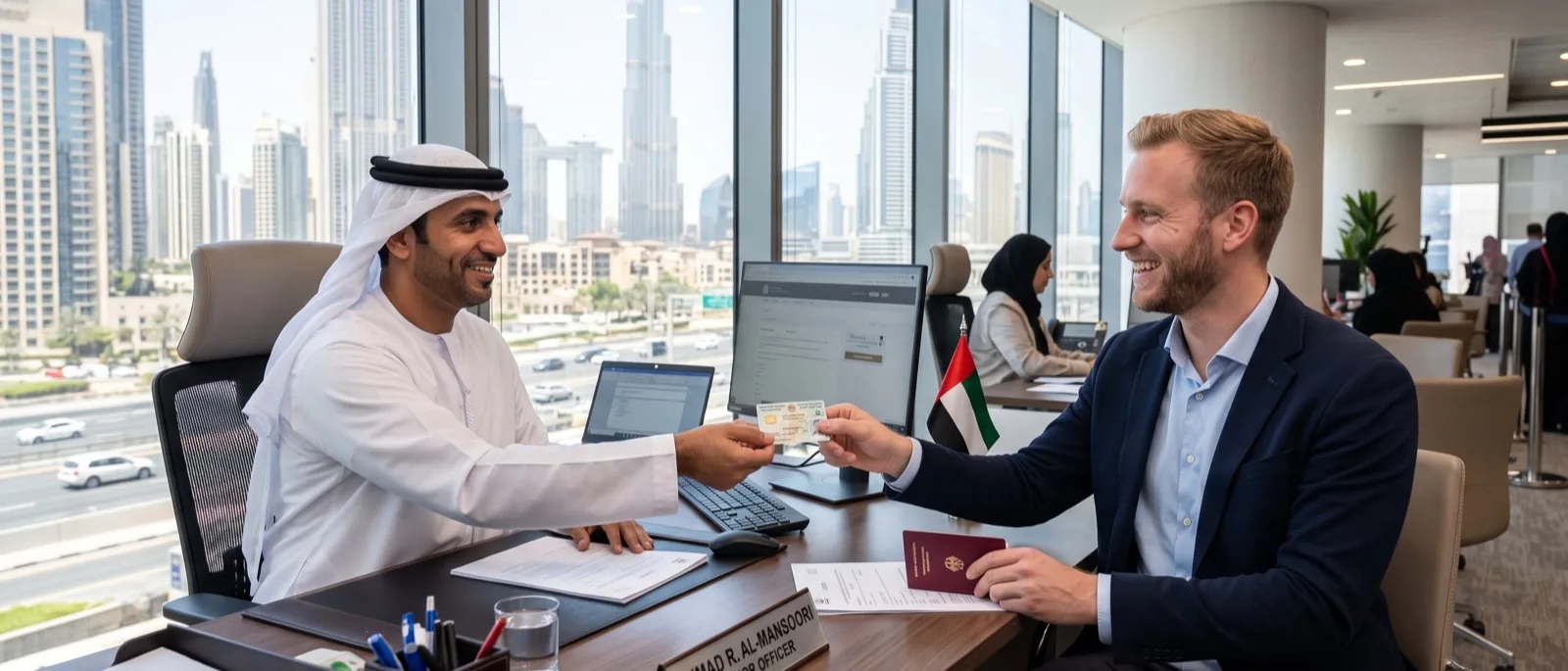
After a few days, you will also receive your Emirates ID by post to the address provided. With this you are now fully capable of living and doing business in the UAE. With the Emirates ID, you can open accounts, conclude rental contracts, rent cars and much more in the UAE.
9. Account Opening
This is followed by the Opening an account with a local bank in Dubai. There is a wide range of options, from local banks and fintechs to major international banks such as HSBC. Depending on your needs and requirements, it is important to choose the right bank. Popular banks among expats include Mashreq, ENBD and Wio, the latter of which is a modern fintech and can be opened relatively easily if you know how.
In general, you should be well prepared when opening an account in order to avoid a rejection.
Depending on the bank, the process can be handled remotely in some cases.
10. Real Estate
Finally, of course, you also need a property to live in. This can be found via Propertyfinder.ae, Bayut.com or through a trusted real estate agent. Whether buying or renting, almost all real estate deals in Dubai usually go through a real estate agent. For rental contracts, 5% commission of the annual rent is taken and for purchases 2% of the total price plus an additional 4% DLD fee.

This point should definitely not be underestimated. Ideally, you should definitely spend the first few days and weeks in an Airbnb and change the area from time to time. This allows you to get to know the city better and what you ultimately like. The Most popular areas among expats in Dubai are among others:
- Downtown
- Business Bay
- Creek Harbor
- Dubai Hills
- Emaar Beachfront
Costs
The total costs of emigration are of course very individual. Decisive factors for the costs are sometimes:
- Number of VISA required
- Type and number of licenses
- Removal company (if necessary)
- Flight tickets
Someone emigrating to Dubai alone without significant possessions and having an agency handle the entire process will typically pay between €6,000 – €10,000. However, this includes a full-service package where everything is covered and optimally arranged or organized.
The Cost of living in Dubai are, on the other hand, highly individual. However, we recommend emigrating only from an income of €5,000 for individuals and €7,500 for couples with children.
| Item | Costs |
|---|---|
| Company formation incl. licence, residence visa, medical, Emirates ID and bank accountFull service through an agency, freezone | 6.000 – 10.000 € |
| Flight | 300 – 600 € |
| Hotel or serviced apartment for the first few weeks | 1.500 – 3.000 € |
| Removal company optional | 2.000 – 5.000 € |
| Total | approx. 8,000 – 19,000 € |
Indicative figures for a single person, as of 2026, rounded. Health insurance is not included, nor are the deposit and Ejari for the flat: both depend far too much on the policy, your age and the property to put a serious number on. What life costs from then on is in the article Cost of living in Dubai.
Error - Please note
When emigrating to Dubai, there are always mistakes that can cause the emigration to fail and result in expats leaving Dubai or the UAE. The following is an overview of the biggest mistakes that can occur when emigrating to Dubai.
Exit taxation in your home country
Leaving is rarely free of tax consequences, and this is where most plans come unstuck. Many countries levy an exit tax when a resident holding a substantial stake in a company moves away: the unrealised gains on that shareholding are treated as if the shares had been sold on the day of departure and taxed accordingly, even though no money has changed hands and nothing was actually sold. Thresholds, rates and deferral options differ widely from country to country, and a move to the UAE rarely qualifies for the relief that is granted for a move within an economic area such as the EU.
Shares are not the only trigger. Depending on where you are leaving from, a business, real estate, a life insurance policy or a pension entitlement can each be treated differently on departure. Some states also apply an extended or trailing tax liability for several years after the move, or continue to tax you as though you were resident if your new home is classified as low-tax.
The practical consequence is the same everywhere: clarify your position before you deregister, not afterwards. Once the move has taken place the valuation date is fixed and most of the options are gone. Have the figures reviewed by an adviser in your current country of residence, this is the one part of the process that cannot be corrected in hindsight.
Deregistration does not mean departure for tax purposes
A mistake that happens again and again: Many people believe that the formal deregistration at the registration office is the end of the matter. Unfortunately, this is wrong. In both Germany and Austria, the tax office does not check where you are registered, but where the Actual center of life interests is located. Anyone who deregisters but still has an apartment, a car, health insurance, an active tax consultant, club memberships or close family ties in their country of origin risks continuing to be classified as a tax resident - with all the tax consequences. Proper deregistration therefore involves not only going to the registration office, but also terminating all contracts that could establish a permanent center of life in the country of origin: Rental contract, car registration, health insurance membership, club memberships and the like. Written confirmation from the tax office that you are moving away for tax purposes is recommended in both countries and should be actively requested.
High cost of living
Even if you don't have to pay taxes or social security contributions in Dubai, the fact is that the Cost of living are generally much higher than in Central Europe. Of course, this always depends on the individual's own standard of living, but as a single person you generally have to reckon with upwards of €5,000 if you want to live reasonably. Many people who are new to Dubai are tempted to share the luxury of others and also share it online. Here you run the risk of living beyond your means and ultimately not saving any money unless you have control over your finances.

Alcohol or drug consumption
The laws regarding alcohol consumption are very relaxed in many European countries, especially Germany and Austria. However, you should be aware that there is no tolerance for drinking and driving in the UAE, and certainly not for drugs. Although the penalties have been reduced, you can still expect severe fines or even imprisonment if you disregard certain laws. Basically Alcohol is in Dubai allowed in private or in certain places, but not in public.

Drugs such as marijuana, cocaine and the like are severely punished.
Disrespect
Showing respect to others is not only a matter of virtue, but also a legal obligation. Anyone who insults or abuses others and cannot control themselves may well be reported to the police and fined. Even simple terms sent via WhatsApp or email are sufficient. In general, politeness and respect for other people and cultures are required by law and the penalties are severe.
Expectations
One of the decisive factors when emigrating to Dubai is the mentality and expectations you bring with you. Many people, especially Germans, take their old attitudes with them to Dubai and expect exactly the same here as in their home country. This applies not only to the laws, but also to simple everyday things such as punctuality or accuracy. Whether these qualities are good or bad is something everyone has to decide for themselves. The fact is that certain things simply work differently in the Arab world, including Dubai, and sometimes you have to be patient or adjust your expectations. Some things go faster, but some things go slower.
Experiences
In our experience, emigration to Dubai has increased significantly in recent years and for good reason. Those who inform themselves in advance, know the advantages and disadvantages and get an idea of the place will emigrate successfully.
Emigration usually only fails if you are uninformed or if you think you can do everything yourself and do not need a service provider for important decisions such as emigration, clarification of exit taxation and immigration on site in Dubai.

Questions about Dubai?
Book a free 20-minute initial consultation with Clemens Kohlbacher, Senior Consultant, and get an honest assessment of whether and how Dubai fits you.
Book nowFrequently asked questions
An overview of the most frequently asked questions when it comes to emigrating to Dubai.
How much money do you need to emigrate to Dubai?
Of course, this depends very much on the standard of living you want to lead. There are guest workers who live on around €1,500. As a rule, if you want to lead the Central European standard of living, you should earn at least €5,000 as a single person in Dubai. Ideally, for more leeway, budget for hobbies and luxury, you should be earning €7,000 per month.
Which professions are in demand in Dubai?
In general, European specialists with a good education are particularly sought after. Above all, areas such as
- IT
- Finance
- Engineering
- Building industry
However, you should have a solid education and professional experience. Career changers will find it very difficult.
What do I need to consider when emigrating?
There are several points that you should definitely consider when planning to emigrate to Dubai. Here is an overview of the most important ones:
- The most important thing is to have a sufficient budget or income. In the UAE, all services have to be paid for privately, i.e. life is more expensive than in Central Europe. However, those who earn well can still benefit greatly, as there are no taxes at a private level.
- You should also be aware of the exit tax, which is a trap for many people and can have legal consequences if you do not plan proactively.
- This also includes the clean deregistration at the tax office, registration office and the termination of contracts and insurance policies.
- In addition, you should have a professional contact person on site for visa applications, company formation, real estate, insurance, driver's license and similar matters to ensure a smooth immigration process with the Emirati authorities.
What happens to the pension paid in so far?
Anyone who has paid into the statutory pension insurance scheme for years - be it the German Pension Insurance (DRV) or the Austrian PVA - is right to wonder what will happen to it if they emigrate to Dubai. The good news is that acquired pension entitlements do not expire. Anyone who has reached the required minimum insurance period (5 years in Germany, 15 years in Austria) can also draw their statutory pension from Dubai at a later date - it will be paid into a specified account. The bad news is that Dubai does not have a social security agreement with either Germany or Austria, which means that years worked in Dubai do not count towards the pension entitlement. So if you emigrate early and do not reach 35 or 45 years of contributions, you will have to make private provisions for old age. In Dubai itself, there is no state pension insurance obligation for expats - private pension provision is entirely your own responsibility.
Can you simply move to Dubai?
No. Staying permanently requires a residence visa, and that only comes through a sponsor: your own company, an employer, a property or the Golden Visa. As a tourist you enter visa-free and can stay up to 90 days, but you may neither work nor live there permanently on that basis.
Can you live in Dubai on 4,000 € a month?
As a single person yes, though without much room to spare: a one-bedroom flat outside the prime areas, groceries and transport are covered. It gets comfortable from around 5,000 € a month; for a couple with a child we reckon on 7,500 €. The full breakdown is in the article Cost of living in Dubai.
How long does moving to Dubai take?
The formal part is quick: company formation three to five working days, then the e-visa, entry, medical test, biometrics and Emirates ID in about one to two weeks on the ground, followed by opening the bank account. Realistically visa, ID and account are in place after four to six weeks. Tax planning should start much earlier, ideally six to twelve months before the move.
Is Dubai really tax-free?
At the private level yes: no income tax, no capital gains tax, no inheritance tax. Since 2023 companies pay 9 % corporate tax on profits above 375,000 AED, plus 5 % VAT on most sales. The details are in the guide Taxes in Dubai.
Can I keep my health insurance from home?
Statutory cover usually ends when you deregister. In any case, health insurance in the UAE is mandatory for the visa and the Emirates ID. A local or international policy is therefore the norm; what it costs and what matters is in the article Krankenversicherung in Dubai.
Summary
Emigrating to Dubai offers many advantages and has rightly been so popular for years. In addition to taxes and a high level of security, Dubai also offers an extensive infrastructure and has been attracting more and more families in recent years. There are few requirements for emigration, the primary factor is money. If you have it, you can emigrate in just a few days.
Thinking about moving to Dubai?
Get our free Dubai relocation guide now: 7 tips on moving, company formation, visas & more.
You might also like