
Dubai has become a particularly attractive business location in recent years. This is partly due to the low taxes, the openness to innovation and the stable banking system. As a result, more and more people are interested in opening an account in Dubai. Both privately and for business.
This comprehensive guide explains everything you need to know about opening a bank account in Dubai, both for expats and non-residents.
- The reasons For a bank account opening in Dubai, conditions, security, and access to the local market are sometimes included.
- The prerequisite For opening an account, the residence visa along with Emirates ID or a minimum deposit of USD 100.000 as a non-resident.
- There are numerous excellent (international) banks in Dubai. These include Mashreq, FAB, ENBD, and HSBC, among others.
- The costs for opening an account are usually 0 AED for residents with an Emirates ID, while non-residents are mostly charged an opening fee of 10,000 AED.
Advantages of an account in Dubai
The advantages of accounts and banks in general in Dubai are extremely diverse. Here are the most important aspects that make banks in Dubai so attractive for entrepreneurs and investors.
- Stability One major point is definitely stability and security. There has not yet been a single bank failure in Dubai. In Germany, Austria and Switzerland, however, there have been a few. Security is sometimes the most important criterion when it comes to entrusting your own money to a bank.
- Terms and conditions The next aspect that stands out in an international comparison is the great conditions. On the one hand, almost all banks offer a fixed interest rate of around 5% on call money accounts. This is many times higher than on a savings account or building society savings account in Europe. On the other hand, the charges are extremely low. This applies both to the monthly amount (only a few dirhams) and to the charges incurred for national and international transfers (0 to a few dirhams per transaction)
- User friendliness The online banking of numerous local banks in Dubai, including apps, is particularly easy to use. The high level of user-friendliness allows numerous transactions to be completed via smartphone. This starts with opening an account, which is 100% digital, as well as with numerous fintech banks that many people appreciate.
- Multi-currency Dubai is an international business location and banking hub. Accordingly, all banks offer multi-currency accounts with native IBANs. EUR, USD, AED, GBP, and many other currencies are included as standard in the basic package. Definitely a big plus for travelers and internationally active entrepreneurs.
- Credit cards For some, this aspect is more important than for others, but banks in Dubai do offer attractive credit cards. For example, the Skywards Infinite Credit Card or the Marriott Bonvoy World Elite Mastercard are absolute must-haves for the mileage chasers.
Requirements
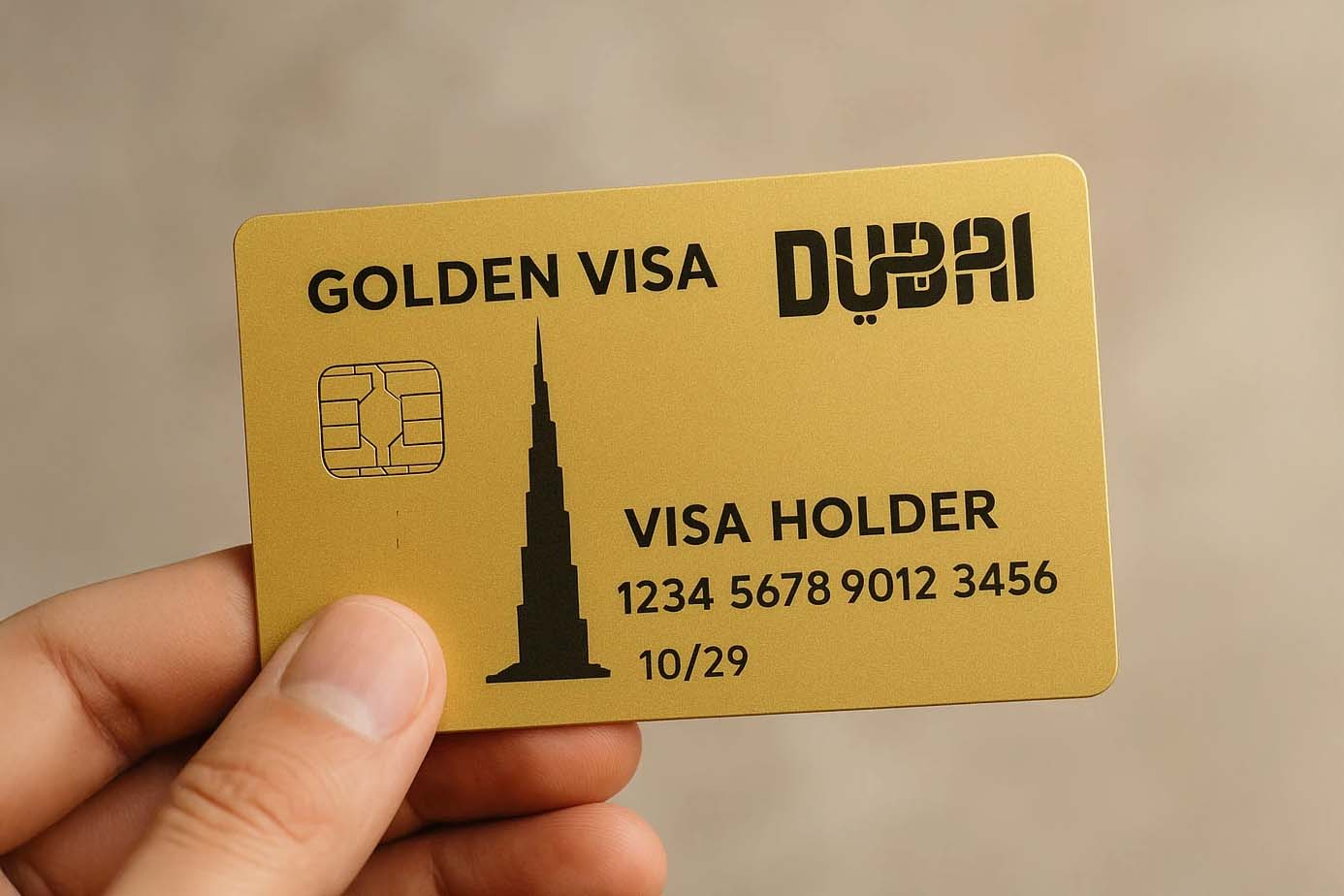
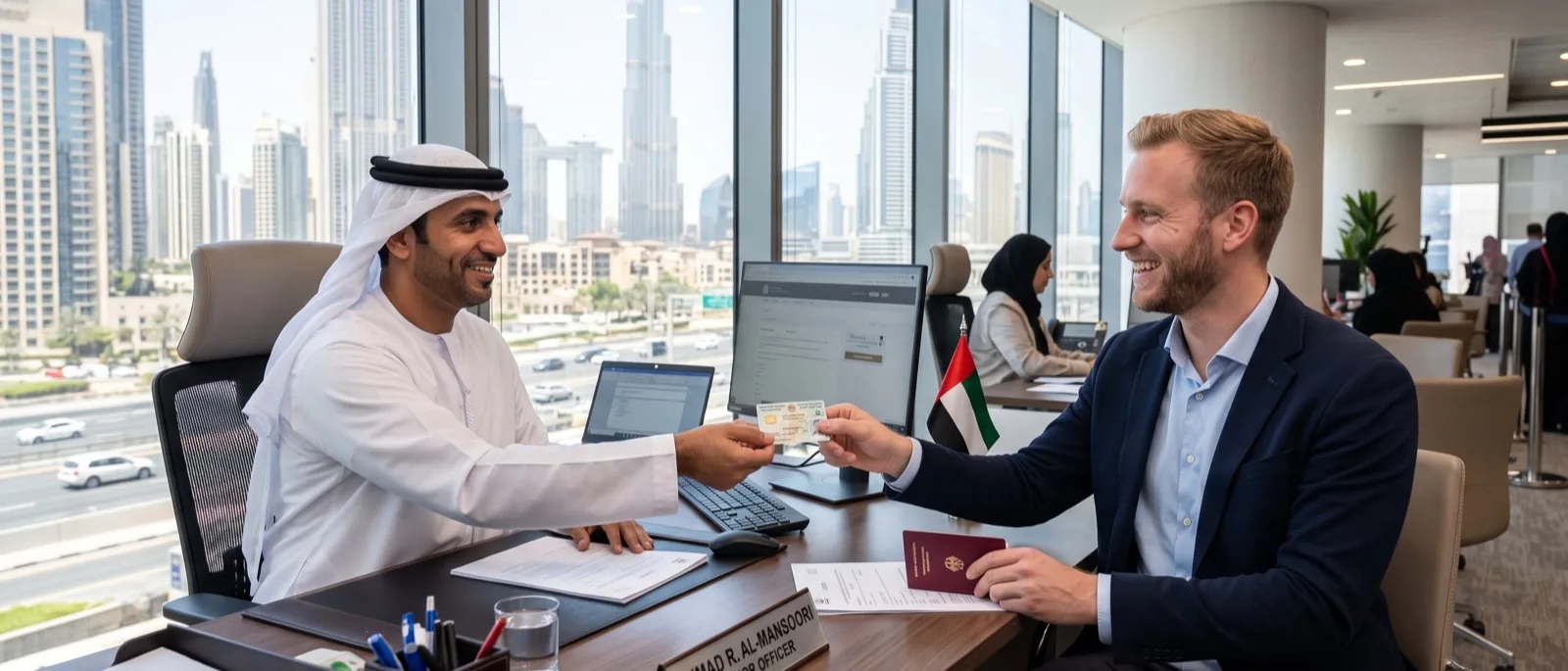
The requirements for opening an account in Dubai differ for retail and business customers. However, a fundamental requirement for both is possessing a valid Emirates ID, this is linked to the residence visa, which one usually receives for company formation or real estate purchase.
Personal account
The requirements for opening a private account are generally lower than those for a business account. The following documents and information are required.
- Emirates ID / Visa
- Address in Dubai (but no proof)
- Salary information
- Details of the employer / entrepreneur
- Source of funds (without proof only indication)
- VAE phone number
Business account
Many new expats and entrepreneurs in the UAE fail to open a business bank account. This is because the banks have become much stricter due to numerous legal requirements. Accordingly, you should be well prepared, as a failed opening can lead to you being blocked by the bank. You should always have the following documents and information to hand.
- Founding documents
- Address / Company Headquarters
- Internet presence (website, LinkedIn etc...)
- Business Plan Light / Description of the company
- Emirates ID / VISA from General Manager
- Source of funds (indication)
Open a Dubai bank account without residency
You definitely do not need to be a resident of Dubai to open an account in Dubai. Having an active VISA along with an Emirates ID is sufficient. However, if you don't have those either, as you are rarely or never in Dubai, the requirements are higher, but it is not impossible. Generally, banks therefore require the following for non-residents:
- 100.000 USD minimum deposit
- Proof of salary 6 months
- Proof of origin of assets
- Proof of employment
- Valid passport
- Current place of residence with proof (every bank requires at least an address)
One distinction matters, and many get it muddled: a residence visa with an Emirates ID makes you a resident in the bank's eyes, and then opening an account runs normally. Without both you are a non-resident, and accounts do exist for that, but far fewer and on different terms.
Which banks take non-residents at all
Not every bank offers it, and the requirements differ widely. The orders of magnitude we work with in practice:
| Bank | Non-resident account | Typical requirement |
|---|---|---|
| Emirates NBD | yesthrough the private/priority segment | high minimum deposit, in-person appointment |
| Mashreq | yesGold Savings for non-residents | AED 500,000 balance or AED 50,000 monthly salary |
| HSBC / Standard Chartered | yesthrough the international customer relationship | an existing account relationship at home helps |
| Wio, Mashreq NEO | nodigital banks | Emirates ID strictly required |
| FAB, ADCB | limited | case by case, usually with proof of assets |
Indicative figures, as of September 2026. Banks change their non-resident policy often and decide case by case; only the bank's own statement is binding. Anyone with a company in the UAE takes the easier route through the residence visa anyway.
Why applications get rejected
For non-residents rejection is the rule, not the exception, and the reasons repeat themselves: no comprehensible link to the UAE, an unclear source-of-funds record, a profession or country of origin on the bank's internal risk list, missing documents in English, or simply too small an amount for the segment in question. Compliance departments have not become more relaxed since the UAE came off the FATF grey list in 2024, quite the opposite.
In practice the fastest route to an account is therefore almost always through your own company: with a freezone licence, residence visa and Emirates ID, opening takes a few working days instead of months, and the minimum deposits drop to a tenth.
Opening an account - procedure
How do you open an account and what is the exact procedure? Below is a step-by-step guide to opening an account.
Choosing a bank
The first step is to be clear about what you actually need an account for and which bank is best suited for this. Not every bank is suitable for everyone. As a general rule, you should also consider choosing the bank for private banking that you also use for business. That makes things a lot easier.
Apart from the services that different banks can offer you, you also need to know and be able to meet the minimum requirements and opening criteria.
Application (via app)
In many cases, it is now possible to apply to open a bank account via the app. Of course, this assumes that you have an Emirates ID and a VISA. If this is not the case, you will need to contact the bank directly, which can also be done via an agency.
The onboarding process in the app usually consists of KYC and the selection of the product at the bank. KYC means that you have to provide the above-mentioned information and documents.
Opening and receiving the card
As a rule, you will receive confirmation that the account has been opened after a few days. If this is not the case, the bank usually requires more documents or information and you should provide these if necessary. If the opening of the account is finally approved, you will receive the card by post.
This card will then be delivered to the current place of residence in Dubai (can also be a hotel or Airbnb). Upon receipt of the card, the Emirates ID and fingerprints are scanned. The card can then be activated in the app and you have a fully functional bank account.
Account management
It is crucial to maintain a clean account and not violate the terms of service. Every bank has the right to permanently close an account. The following basic rules are important to observe:
- No high 5 to 6 digit transactions from crypto exchanges
- No transactions in prohibited jurisdictions
- Do not use the account only as a transfer account
The best banks in Dubai
Which bank should you open an account with now? There is no general answer to this question, as different banks offer different conditions. However, the following banks offer similar and attractive conditions for most investors and users. Both in the private and business sectors.
ENBD
One of the most popular banks is the local bank ENBD, short for Emirates National Bank of Dubai. This bank is headquartered in Dubai and is one of the largest banks in the UAE. The good infrastructure and modern online banking make this bank very popular.
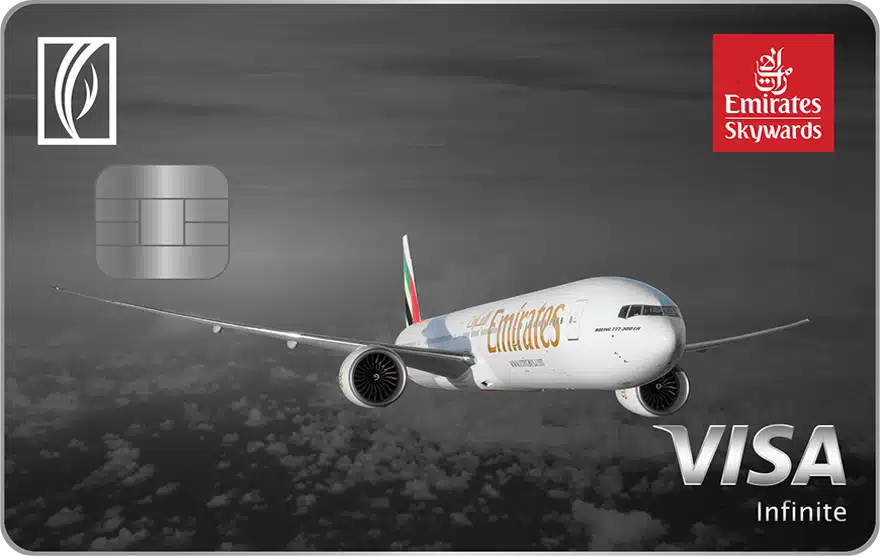
One of the main reasons for this is the credit card such as the Infinite Skywards Credit Card or Marriot Bonvoy World Elite Card, with which you can earn very good miles or points. Almost a must-have for travelers.
Mashreq
The oldest bank in the UAE is Mashreq Bank, and the level of trust in this bank is correspondingly high. Mashreq is also headquartered in Dubai, and the infrastructure for expats living in Dubai is consequently excellent. Mashreq is particularly popular due to its low transaction fees with the Quick Remit function, as it allows for real-time international transfers.
The Mashreq Gold program is also available for wealthy customers. This enables better support at the bank, lower charges or better FX rates and higher interest on deposits. As a rule, this starts at AED 100,000.
FAB
One of the largest banks in the UAE is FAB, short for First Abu Dhabi Bank. Headquartered in Abu Dhabi, the bank is also very popular in Dubai and has several branches in Dubai. FAB is basically suitable for everyone, although the FAB Elite program is very attractive for wealthy customers thanks to special benefits such as lower charges, higher interest rates and much more. Of course, this includes a minimum deposit.

Business accounts are rather difficult to obtain here if you run a freezone company. As a rule, the requirements are high and you have to reckon with a 6-digit minimum deposit.
Wio
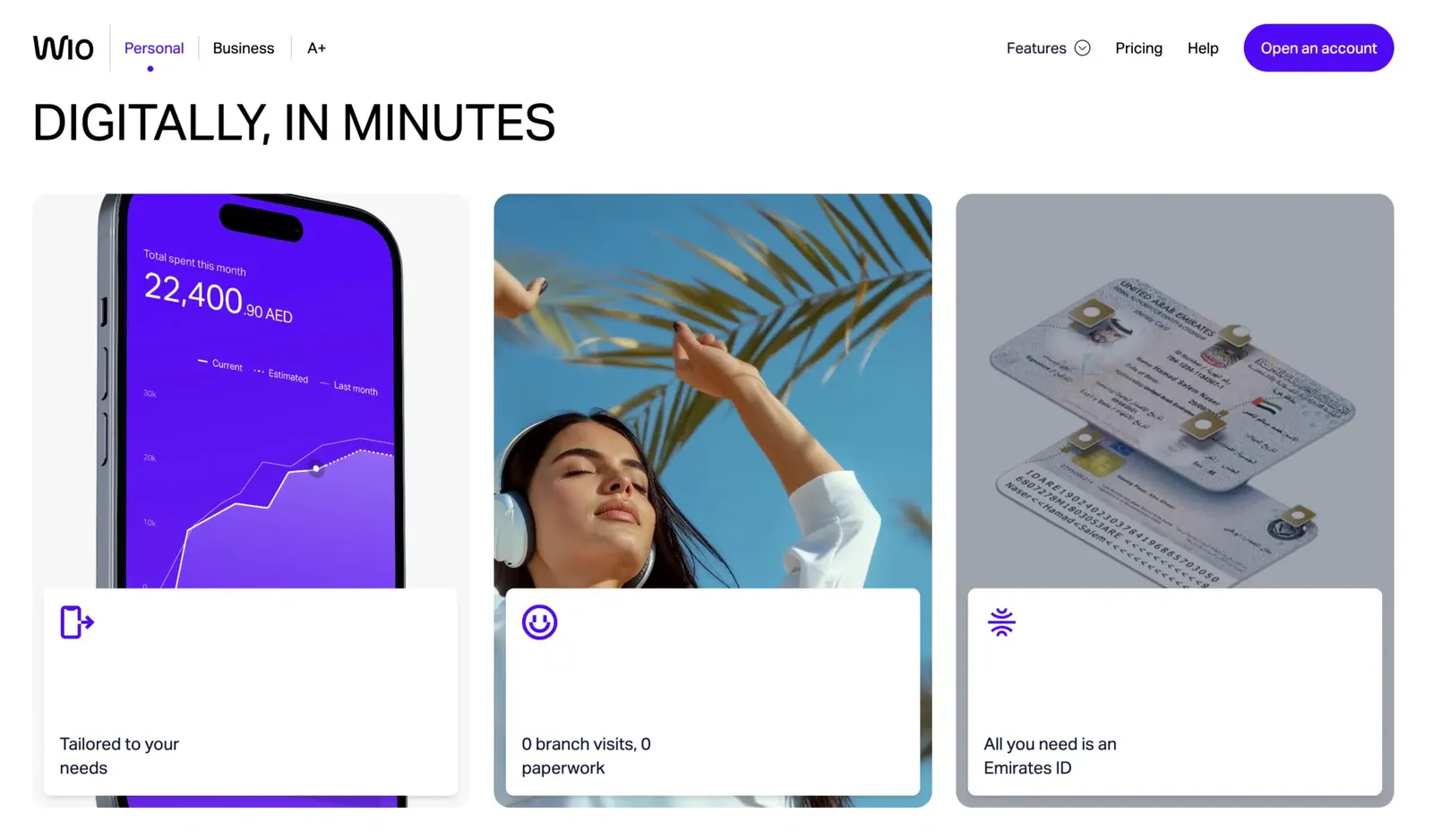
Fintech is also on the rise in the UAE and the best fintech solution on the market is currently Wio. The subsidiary of FAB is a purely digital banking solution and impresses with state-of-the-art online banking and complete processing purely via the app. The fees are also very low and onboarding works without any problems for most people.
ADCB
The third largest bank in the UAE is Abu Dhabi Commercial Bank. As the name suggests, its headquarters are in the Emirate of Abu Dhabi and its target group is primarily (mainland) companies. As a rule, Freezone companies cannot open a business account with ADCB. However, private accounts are certainly possible.
Interest on balances in Dubai
This point is regularly underestimated with an account in Dubai: on the current account there is practically no interest, but savings and fixed-deposit accounts pay rates well above what European banks currently offer. And the real difference comes afterwards: interest income is tax-free in the UAE, there is no capital gains tax and no savings allowance you would have to use up.
Savings accounts
The digital banks lead here. Wio pays interest on AED balances through its Saving Spaces at around 3 % p.a. with daily availability, and more with salary crediting or on the family plan. On the NEO Plus Saver, Mashreq pays up to 6.25 % p.a., but requires salary crediting from AED 10,000 a month. The classic branch banks sit lower: Emirates NBD's Smart Saver moves around the 1 % mark depending on currency.
Fixed deposits
For tied-up money the rates in September 2026 range, depending on bank and term, between about 3.5 and 4.5 % p.a., and above that on individual promotional offers. Terms usually run from one week to five years, with minimum deposits from AED 5,000 to 25,000. Islamic banks such as DIB pay no interest in the strict sense but a profit share on the wakala principle; economically it comes to the same thing.
Sources: emiratesnbd.com, mashreq.com, wio.io, market overview stashaway.ae (as of 2 September 2026)
Currency: the dirham is pegged to the dollar
The AED has been firmly pegged to the US dollar since 1997, at a rate of 3.6725 AED per USD. An AED balance is therefore effectively a dollar balance: against the euro you carry the full EUR/USD exchange-rate risk, and that can outrun the interest differential in either direction. Anyone living in Dubai who earns and spends in dirhams does not feel it; anyone moving money here from Europe for the interest should factor it in.
Interest, dividends and capital gains remain untaxed at the private level anyway. What other levies arise in the UAE is set out in the guide Taxes in Dubai.
Costs
The costs for opening an account in Dubai can generally be divided into two categories: opening fees and monthly account maintenance fees.
Setup costs (one-time)
Anyone with an Emirates ID can generally open a bank account for free at any bank. There is usually no account opening fee. However, some banks (rather rarely) may require a minimum balance.
For non-residents, meaning all those who do not possess an Emirates ID, the situation looks significantly different. Here, a minimum deposit of $100,000 USD is always required. Since opening an account for non-residents is relatively difficult, there are agencies that specialize in this. They typically charge 10,000 AED for the opening.
Account maintenance
The ongoing account maintenance fees vary greatly from bank to bank. Usually, these are also tied to the deposit, which can cancel them out. Banks like ENBD or HSBC reduce the monthly costs the higher the deposit or bank account balance is.
Personal account in Dubai, monthly costs compared
| Bank | Minimum balance | Fee if below / month | With salary transfer |
|---|---|---|---|
| Emirates NBD (ENBD) | AED 3.000 approx. 750 € | approx. AED 26–52 approx. 6–13 € (depending on plan) | free from AED 5.000 salary |
| Mashreq (NEO) | AED 3.000 approx. 750 € | approx. AED 25 approx. 6 € | free from AED 5.000 salary |
| FAB (First Abu Dhabi Bank) | AED 3.000 approx. 750 € | AED 26.25 approx. 7 € | free (FAB One, with salary) |
| Wio (Personal) | none | none standard plan free | free |
| ADCB | AED 5.000 approx. 1.250 € | AED 26.25 approx. 7 € | free with salary transfer |
Personal accounts in the UAE usually have no fixed monthly fee, but a minimum balance (“monthly average balance”). If it is not met, the “fall-below” fee applies: with a regular salary credit it is usually waived entirely.
Business account in Dubai, monthly costs compared
| Bank | Monthly fee | Minimum balance (MAB) |
|---|---|---|
| Emirates NBD (ENBD) | no fixed base fee if MAB maintained below minimum ~AED 100+/mo. · approx. 25 €+ | depending on account type, often from AED 25,000–50,000 approx. 6.250–12.500 € |
| Mashreq (NeoBiz) | Lite: AED 200 approx. 50 € (no minimum balance) Prime: AED 0 if the MAB is maintained |
Lite: none Prime: AED 50.000 approx. 12.500 € |
| FAB | from approx. AED 50 approx. 13 € (Business Basic) | from AED 50,000 depending on tier approx. 12.500 € (höhere Tiers 250k/500k) |
| Wio (Business) | from AED 99 approx. 25 € | none |
| ADCB (Business Choice) | Silver AED 150 · Gold AED 200 · Platinum AED 300 approx. €38 / 50 / 75, only if the balance falls short; Gold/Platinum is waived from AED 100,000 MAB | from AED 10.000–25.000 approx. 2.500–6.250 € |
Business accounts depend heavily on the account type. Fintechs (Wio, Mashreq NeoBiz Lite) charge a fixed monthly fee without minimum balance; traditional banks tie the fee to a minimum balance (MAB), which waives the fee when maintained.
Note: All figures include 5 % VAT, as of July 2026, without warranty: bank fees change constantly, please check with the institution before opening an account. The AED is pegged to the US dollar (≈ 3.67 AED/USD); EUR figures are rounded approximations at ≈ 4 AED/€ and move with the exchange rate.
Personal accounts in the UAE generally have. no fixed monthly fee, but a minimum balance („Monthly Average Balance"). If this is not met, the aforementioned „fall-below" fee will be charged: with regular salary deposits, it is usually waived entirely.
Business accounts are highly dependent on the account type. Fintechs (Wio, Mashreq NeoBiz Lite) charge a fixed monthly fee. without Minimum balance, traditional banks link the fee to a minimum balance (MAB), which waives the fee if met.
Note: All figures include 5 % VAT, as of July 2026, subject to change: bank fees are subject to change; please check with the respective financial institution before opening an account. The AED is pegged to the U.S. dollar (≈ 3.67 AED/USD); EUR amounts are rounded approximations of ≈ 4 AED/€ and fluctuate with the exchange rate.
Terms per the banks' schedules of charges, as of September 2026: emiratesnbd.com, mashreq.com, wio.io. Banks adjust their fees continually; only the current schedule of charges is binding.
Offshore account, CRS and what the bank reports
Behind the question about an account in Dubai there is often a second one, rarely asked openly: does the tax office back home find out about it? The short answer is yes, and automatically.
The UAE introduced the Common Reporting Standard of the OECD on 1 January 2017, and the first exchange of data took place in 2018. Since then banks report account balances and income of customers who are tax resident elsewhere to the UAE finance ministry each year, which passes the data on to the relevant home authority. More than 100 states take part, Germany, Austria and Switzerland among them. That is precisely why every bank asks about your tax residency and tax identification number when you open an account, and why a false statement here is no trifle.
That also settles the question of the classic offshore account: an account in Dubai is not a hiding place, but a normal account in a country without capital gains tax. Its advantage only arises once you are tax resident here yourself, that is with a residence visa, an Emirates ID and an actual centre of life. Then the interest is taxed neither in the UAE nor in your former home country, and there is nothing left to report either, because you are no longer resident there.
Frequently asked questions
Below is an overview of frequently asked questions regarding opening an account in Dubai.
Can I open an account in Dubai without residency?
Yes, that is possible, however, a minimum deposit of $100,000 USD must be made and also maintained.
Can I open a bank account in Dubai online?
As an Emirates ID holder, you can easily open an account online with various banks, such as Wio. You only need to be present for the delivery of the physical card.
Those without an Emirates ID are forced to enter.
Is it possible to open an anonymous bank account?
In principle, bank accounts in Dubai are anonymous; however, Dubai participates in the CRS, which allows for data exchange with the respective country of the stated residential address.
How long does opening an account in Dubai take?
With a residence visa and an Emirates ID it is quick: with the digital banks Wio and Mashreq NEO the account is often in place within 24 to 48 hours; at the classic banks it usually takes three to ten working days. Without an Emirates ID, as a non-resident, plan for several weeks, because the compliance check runs considerably longer.
Which documents do I need for an account in Dubai?
For a personal account as a resident: passport, Emirates ID, residence visa and usually proof of income or salary. For a business account add the trade licence, incorporation documents, list of shareholders and a business plan or existing contracts. Non-residents must additionally evidence the source of funds, for instance with the last six months of bank statements.
How much interest does an account in Dubai pay?
On the current account practically none. Savings accounts pay around 3 % p.a., with Mashreq NEO Plus up to 6.25 % under conditions; fixed deposits bring roughly 3.5 to 4.5 % p.a. depending on term. Interest income is tax-free in the UAE. Details in the section Interest on balances.
What does an offshore account in Dubai achieve?
Less than many expect. Since the CRS exchange began in 2018 the UAE automatically reports balances and income to your home authority if you are tax resident there. The advantage only arises with your own residency in the UAE, but then it is substantial: 0 % on interest, dividends and capital gains.
Does my bank in Dubai report data to my home country?
Yes, if you are tax resident there. The UAE has participated in the Common Reporting Standard since 2017, with the first exchange in 2018. What is reported is the balance and the income, not individual transactions. Anyone who has genuinely moved their residence and is resident in the UAE drops out of the reporting.
Why is my application rejected?
The commonest reasons are a missing link to the UAE, unclear evidence of the source of funds, an industry on the bank's internal risk list or too small a deposit for the chosen segment. For non-residents rejection is rather the rule; with a company and an Emirates ID the ratio flips entirely.
Do I need a UAE company for a business account?
Yes. A company account requires a valid trade licence, whether freezone or mainland. The bank checks not only the licence but also the business model, the customer base and the expected flows of funds. How incorporation works is set out in the guide How to Start a Business in Dubai 2026: Step-by-Step Guide & Costs.
Summary
Opening a bank account in Dubai is generally possible for both residents and non-residents. However, you need at least an Emirates ID and a VISA. If this is not the case, a minimum deposit of USD 100,000 and other requirements must be expected. At best, it is possible. There are numerous banks that offer banking solutions at attractive conditions, including ENBD, Mashreq, FAB and Fintech Wio.
Thinking about moving to Dubai?
Get our free Dubai relocation guide now: 7 tips on moving, company formation, visas & more.

You might also like