Living in Dubai is a key issue for all expats coming to the UAE. The city is large and so is the selection of residential properties. That's why many people ask themselves where to live and which residential area is best for me?
This article answers that question with an overview of the most popular residential areas in Dubai and their pros and cons. It also covers current rents per area, which area suits which stage of life, and what to look out for in the tenancy contract. What living in Dubai costs overall is covered in the guide Cost of living in Dubai.
- Location decides your daily routine. Dubai is spread out, and the drive to work easily takes over an hour in rush hour. Living close to work and school wins back time every single day.
- The range runs from AED 40,000 to more than AED 400,000 a year. A studio in Jumeirah Village Circle costs around AED 54,000, two bedrooms in Downtown more than AED 220,000.
- Popular with expats are Creek Harbour, Dubai Hills and the Marina. Families tend to head for Arabian Ranches, Mirdif or Dubai Hills.
- Renting works differently than in Europe. Rent is quoted for the year and paid in one to four cheques, plus agency fee, deposit and the Ejari registration.
Where to live in Dubai? 5 criteria
Here are the 5 most important criteria when it comes to choosing the right apartment, villa or townhouse. There is no such thing as the best residential area in Dubai. You should always make your choice individually and consider the following criteria.
Location
Probably the most decisive factor for many is the location. After all, Dubai is big and traffic has also increased in recent years. Accordingly, it is important to find the right property in a location where you feel comfortable and which is also close to the main routes you regularly take.
If you work downtown, for example, you probably shouldn't live in the marina. The journey can take over 1 hour during rush hour.
Price
The decisive factor is, of course, the price of the property or your own budget. Hardly any other city offers such a wide range of prices. A studio in a mid-range area such as Jumeirah Village Circle costs around AED 54,000 a year, roughly EUR 1,100 a month. A five-bedroom villa in Dubai Hills, by contrast, runs to more than a million AED a year.
Connections
Dubai grows faster than its roads. Anyone commuting daily should look at the connection, not just the distance. The metro essentially follows Sheikh Zayed Road and therefore covers Marina, JLT, Business Bay and Downtown. Areas such as Dubai Hills, Arabian Ranches or Al Barari, on the other hand, are reachable only by car.
For families the school run comes on top. Many international schools sit in Dubai Hills, Al Barsha or Jumeirah, and the school bus only picks up in defined areas. Which schools exist and what they cost is covered in the guide international schools in Dubai.
Infrastructure
What has become increasingly important is the infrastructure within a community or residential area. After all, having a gym, hairdresser, pharmacy and supermarket within walking distance saves a lot of time and money. The major developers have now recognized this and are planning not only buildings but also entire communities in a targeted manner. This is called a master developer. However, not all areas have one.
Quality
Another important aspect is the quality of the residential area in terms of construction quality. There are major differences here, as different communities are built by different developers. In some cases, there are also differences within a community, as several developers build in some communities at the same time. Creek Harbour, for example, is being built purely by Emaar, while there is a mix in Meydan.
The best residential areas in Dubai
Here is an overview of the best residential areas in Germany that have been particularly popular with expats for years.
Creek Harbour
Among German expats, Creek Harbour is probably number #1. The relatively new residential area is just 15 minutes from downtown and only 10-15 minutes from the airport. It also offers great sunset views of Downtown and the Dubai skyline.
The community itself offers everything you need for everyday life. From supermarkets and restaurants to pharmacies and even a hospital (Mediclinic Creek Harbour).
In the middle of Creek Island there is a park where children can play or run. There is also a kilometer-long promenade around the island.

The average asking rent for apartments sits at around AED 158,000 a year, across all unit sizes.
Emaar Beachfront
Miami Beach in Dubai. This is exactly what you get with Emaar Beachfront. The raised sandbank between the Palm and JBR offers beachfront living with brilliant views of the skyline and the open sea. Prices in the area have risen sharply, but are still affordable for most expats.
Those looking for that vacation feeling are drawn to Emaar Beachfront.
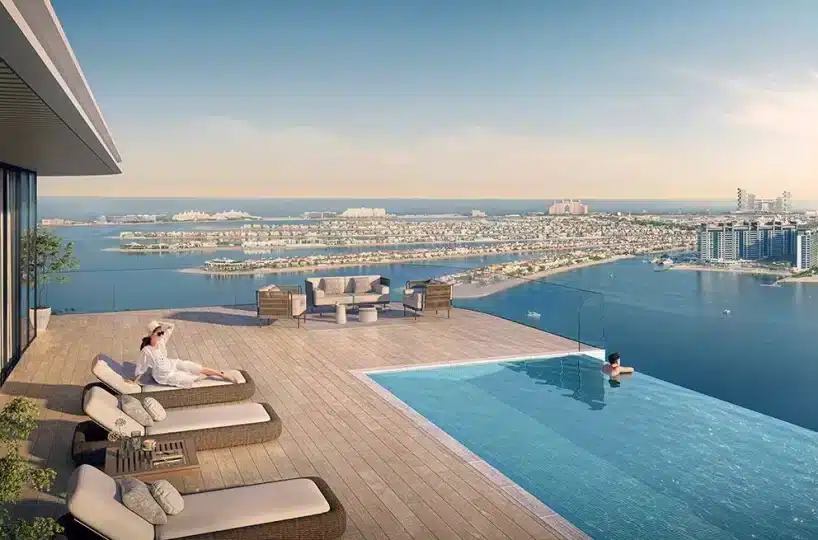
However, the infrastructure is not quite as good as in other areas, as the project is not yet fully completed and space is also limited.
Asking rents average around AED 204,000 a year, putting the area at the upper end of the market.
Dubai Hills
The heart of Dubai is in Dubai Hills. This is because it is located right in the middle between the two centers of Downtown and Marina/JBR. If you travel a lot, Dubai Hills is probably the best location, as you can get everywhere relatively quickly from here.
The community itself offers the largest park in Dubai and probably also the best mall. The Dubai Hills Mall is absolutely untouristic and yet offers everything you need. Accordingly, it is very popular with residents.

Dubai Hills is also home to King's College Hospital, one of the best hospitals in Dubai.
If you want to live here, you will find everything from exclusive villas to terraced houses and simple studio apartments. The area is now very large and well developed.
Port de La Mer
European life on the beach can be found in Port de La Mer. Modeled after the port city of Tivat in Montenegro, here you will find low-rise buildings in a beautiful community right by the sea. All residents have access to the marina and the beach, which is located on the other side of the peninsula.

In terms of location, you are more in the north of Dubai, which you should be aware of. The price here is also higher than most new communities due to the limited number of residential units, tranquillity, quality and infrastructure.
Downtown
Big city life in Dubai can definitely be found in Downtown. There are numerous skyscrapers here, including the tallest building in the world, the Burj Khalifa. The world-famous Dubai Mall with its fountain show is also right next door.
Here you will find all the infrastructure you need for daily life, except for a park for walking.
In terms of price, it is still in the middle class compared to other residential areas in Dubai.
Meydan
Meydan is a new up-and-coming district with a good location. The district is close to downtown and has developed enormously in recent years. However, it is still a large construction site and there is building work going on everywhere. The location and new buildings make the district very popular.
Shobha, one of the best developers in Dubai, also builds a lot here, which gives you a higher quality of construction. However, many other developers (Nakheel, Ellington, Azizi...) are also building in Meydan, which makes the prices and supply very different.
Al Barari
“Life is better in Dubai!” This is a sentence that probably everyone knows, and it comes from Prince Marcus of Anhalt. He is also known for his large villa and his Halloween party in Dubai. This takes place in Al Barari. The green residential district is a bit off the beaten path, but offers a lot of peace and quiet and green spaces. You might almost think you're in Europe. It takes 20-30 minutes to get to Downtown and the Palm, but the most important things are available here, and you can have everything delivered.

However, the price is definitely above average. Here you pay for peace and exclusivity.
Dubai Marina and JBR
The Marina is the densest high-rise district in the city and for many the essence of Dubai. Towers with views over water and skyline line the artificial canal, with restaurants, supermarkets and a promenade below. JBR sits right next door with its own stretch of beach.
The big advantage is the connection. Two metro stations, the tram and Sheikh Zayed Road are on the doorstep, and almost everything can be done on foot. The drawback is the traffic inside the district and the trip to Downtown, which takes a good hour in rush hour.
A one-bedroom apartment in the Marina costs around AED 103,000 a year, a two-bedroom about AED 157,000.
Jumeirah Village Circle (JVC)
For many, JVC is the first address after arriving. The district sits between Marina and Dubai Hills, consists mostly of low-rise buildings and townhouses, and is one of the few areas with affordable rents in a reasonably central position.
A studio there costs around AED 54,000 a year, a one-bedroom apartment about AED 79,000. In return there is no metro station, and parts of the district are still building sites. Anyone after quiet should look closely at the exact street, because the differences within JVC are large.
Business Bay
Business Bay adjoins Downtown to the south and is the choice for anyone who wants to live and work centrally. Office and residential towers stand close together along the Dubai Canal, and many units are smaller and available furnished.
At around AED 73,000 for a studio and AED 104,000 for a one-bedroom, the district sits clearly below Downtown, in an almost identical location and with its own metro station. In return it is louder, and green space is scarce.
Palm Jumeirah
The Palm is the best known residential area in the city. Villas with private beach access sit on the fronds, apartment buildings and hotels on the trunk. Living here means quiet with water on the doorstep.
That comes at a price, and with a catch in the location. A one-bedroom apartment costs around AED 169,000 a year, a two-bedroom about AED 249,000. There is also only one access road onto the Palm, so anyone commuting to Downtown daily sits in traffic regularly.
Arabian Ranches and Damac Hills
Anyone looking for a villa with a garden usually ends up in the villa communities in the south of the city. Arabian Ranches is the most established of them, with its own school, golf course and a settled neighbourhood. Damac Hills lies further out and is cheaper.
A three-bedroom villa costs around AED 170,000 a year in Arabian Ranches 3 and about AED 211,000 in Damac Hills. Nothing works here without a car, but families get space, quiet and short trips to schools and parks.
Mirdif and Dubai Silicon Oasis
Both areas lie away from the skyline and are popular with families watching the budget. Mirdif is an established district with houses, parks and a short hop to the airport. Dubai Silicon Oasis is younger, more densely built and sought after above all by young families.
A three-bedroom villa in Mirdif runs to around AED 142,000 a year, well below Arabian Ranches. The price for that is distance: reaching Downtown or the Marina takes 30 to 50 minutes depending on traffic.
What does renting in Dubai cost?
Rent in Dubai is quoted for the year, not the month. The figures below are average rents from the Bayut rental market report for the first half of 2026, so not asking prices but averages across many contracts.
| Area | Studio | 1 bedroom | 2 bedrooms |
|---|---|---|---|
| Jumeirah Village Circle | AED 54,000 | AED 79,000 | AED 113,000 |
| Business Bay | AED 73,000 | AED 104,000 | AED 148,000 |
| Dubai Marina | AED 65,000 – 75,000asking range | AED 103,000 | AED 157,000 |
| Downtown | no figure | AED 133,000 | AED 223,000 |
| Palm Jumeirah | no figure | AED 169,000 | AED 249,000 |
| Al Nahda | AED 44,000 | AED 56,000 | AED 72,000 |
| Deira | AED 40,000 | AED 66,000 | AED 109,000 |
Average annual rents for apartments, first half of 2026, according to the Bayut rental market report. The figures are averages across all buildings in an area. Between an older tower and a new build in the same community the gap quickly reaches 30 percent.
For families looking for a villa the market looks different. Here are the average rents in the most sought-after villa communities.
| Villa community | 3 bedrooms | 4 bedrooms | 5 bedrooms |
|---|---|---|---|
| Mirdif | AED 142,000 | AED 166,000 | AED 193,000 |
| Arabian Ranches 3 | AED 170,000 | AED 341,000 | AED 419,000 |
| Damac Hills | AED 211,000 | AED 230,000 | AED 404,000 |
| Dubai Hills Estate | no figure | AED 359,000 | AED 1,017,000 |
Average annual rents for villas, first half of 2026, according to the Bayut rental market report. All figures are guide values and move with the market.
Anyone paying the annual rent in a single cheque usually negotiates 5 to 10 percent off. With four cheques you pay the full price but spread the sum across the year.
Which area suits whom?
There is no best residential area, only the right one. Four typical cases and the areas that fit them.
Families with children
What counts is the school run, space and a safe outdoor area. Dubai Hills combines both: villas and apartments, the largest park in the city, a mall and several international schools inside the district. Anyone wanting more space for the money looks at Arabian Ranches, Damac Hills or Mirdif. Creek Harbour is the choice for families who would rather live in a new community with a promenade than in a villa compound.
Single professionals
Anyone moving alone usually wants short distances and company. Business Bay, the Marina and JLT offer small units, often furnished, plus metro, gyms and restaurants on the doorstep. JVC is the cheaper option with more space for the money, but it demands a car.
Couples without children
For couples, leisure value counts for more than the school run. Emaar Beachfront and JBR put the beach on the doorstep, Downtown and Business Bay deliver city life, Port de La Mer is the quiet option by the water. All three directions work without compromising on the size of the flat.
Small budget
Below AED 60,000 a year it gets tight in central locations. Realistic options are then Jumeirah Village Circle, Dubai Silicon Oasis, Al Nahda or Deira. Shared flats are common in Dubai, but only permitted if the main tenant has it in the contract.
Tenancy contract, extra costs and deposit
In Dubai you rent for a full year. Payment is by cheque, usually one to four cheques for twelve months. The contract runs for a year and renews unless one side objects 90 days in advance.
On top come one-off costs. The agency fee is around five percent of the annual rent, the deposit five percent, ten for furnished flats. Registering the contract with Ejari costs about AED 220, and signing up with DEWA for power and water asks for AED 2,000 to 4,000 as a deposit depending on the size of the home.
In many new buildings the cooling is billed separately, the so-called chiller system. If the contract says «chiller free», it is included. If it is not mentioned, several hundred dirhams a month can be added in summer.
Rent increases are capped. How much the landlord may ask on renewal is calculated by the official rent calculator of the RERA authority. The basis is the rent index, not the owner's wish.

Questions about Dubai?
Book a free 20-minute initial consultation with Clemens Kohlbacher, Senior Consultant, and get an honest assessment of whether and how Dubai fits you.
Book nowFrequently asked questions
An overview of the most frequently asked questions about living in Dubai.
How expensive is housing in Dubai?
The price range is huge, hardly any other city offers housing at such a different price. For a decent 1 BDR apartment, however, you can expect to pay €2,000-2,5000.
Where do Germans live in Dubai?
Most German expats live in Creek Harbour, Dubai Hills and Marina.
Where do Emiratis live in Dubai?
Locals or Emiratis live mainly in the beach districts of Jumeirah 1-4, where expats are allowed to rent, but ownership is reserved for Emiratis.
Which area in Dubai is the cheapest?
Among the cheapest areas with workable connections are Deira, Al Nahda and International City. A studio there runs between AED 35,000 and 44,000 a year. Anyone wanting to live more centrally finds studios in Jumeirah Village Circle from around AED 54,000.
Which area is best for families?
Dubai Hills, Arabian Ranches and Mirdif. All three offer houses with gardens, parks and international schools close by. Creek Harbour is the newer alternative for families who would rather live in an apartment with a promenade.
Which residential areas have a metro station?
The metro essentially follows Sheikh Zayed Road. Directly connected are Marina, JLT, Business Bay, Downtown, Al Nahda and Deira. Dubai Hills, Creek Harbour, Arabian Ranches and Al Barari can only be reached by car or taxi.
How does paying rent in Dubai work?
The annual rent is paid by cheque, usually in one to four cheques. Paying everything in a single cheque usually knocks 5 to 10 percent off. On top come the agency fee, the deposit and registering the contract with Ejari.
Should you rent or buy in Dubai?
For the first year renting is the safe choice, because areas feel completely different once you actually live there. Anyone staying does the maths on buying. How that works is covered in the guide buying an apartment in Dubai.
How long does finding a home in Dubai take?
Reckon with two to four weeks. Many expats rent furnished or on a monthly basis for the first few months and look for the right area from there, without pressure.
Three questions settle it: where will you drive every day, how much may the annual rent be, and do you need a garden or is a balcony enough? Anyone who answers those three has usually narrowed the choice to two or three areas. The rest is sorted by a week of trial living on the ground.
Summary
Living in Dubai is a comprehensive topic, as the choice and differences between residential areas in Dubai are huge. It is therefore advisable to inform yourself well in advance, even to rent on a monthly basis and to test several areas at the beginning. Location, price, quality and infrastructure are decisive factors.
Thinking about moving to Dubai?
Get our free Dubai relocation guide now: 7 tips on moving, company formation, visas & more.
You might also like