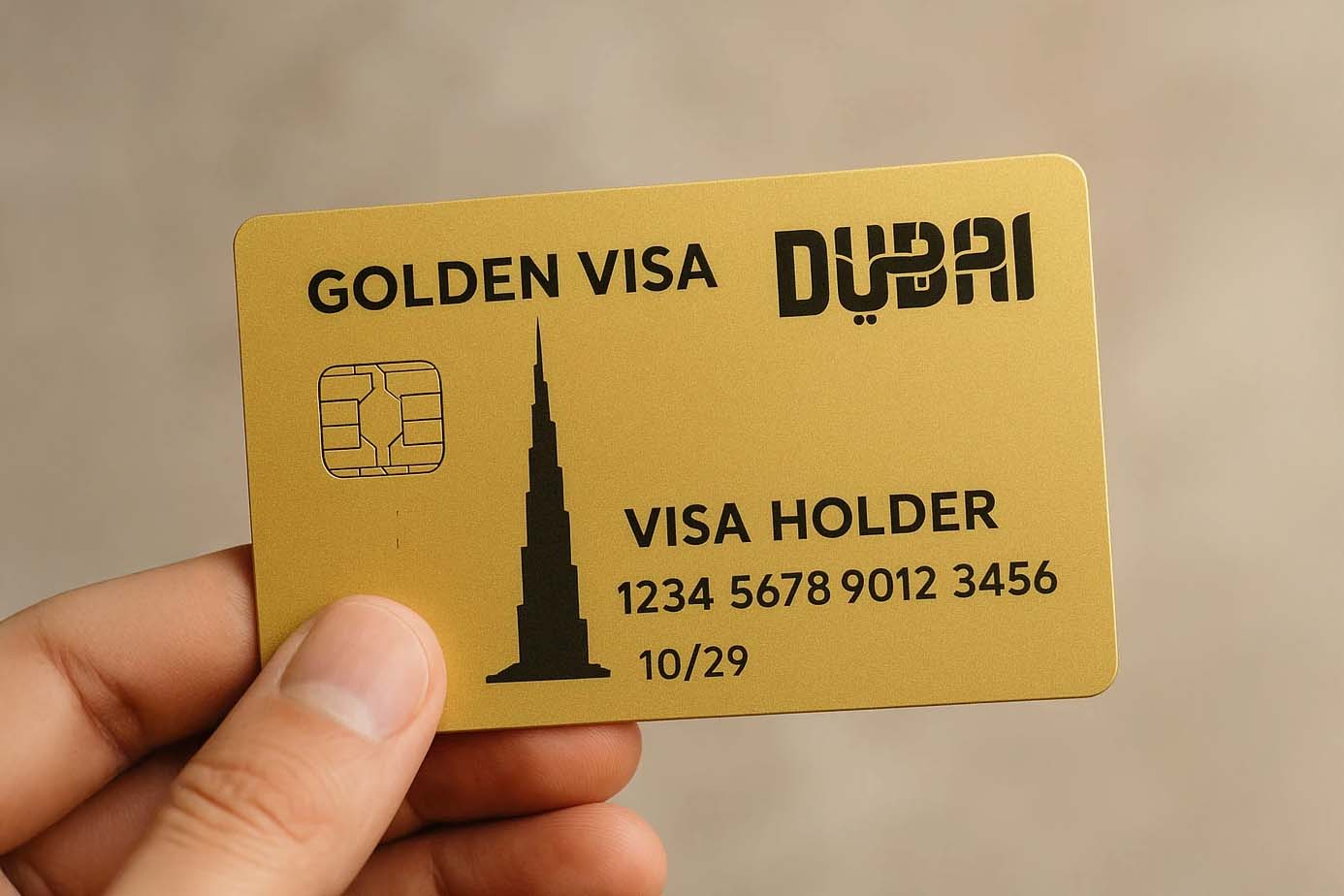
If you want to emigrate to Dubai, there's no getting around it: the Emirates ID. The key document is necessary if you want to open bank accounts, buy real estate or do business in Dubai or the UAE.
But how do you get the Emirates ID, what are the requirements and what is the exact procedure and costs? Everything about the Emirates ID in this comprehensive guide.
- The Emirates ID is an identity card for all expats living in Dubai and enables easy identification and authentication for government procedures, banks, and contracts of all kinds.
- The Prerequisite A valid residence visa is required to obtain it. This is usually obtained through a job, starting a business, or an employer.
- The Costs are around 2,135 AED (about €500) to obtain them. When processed through an agency with personal assistance, it is usually more.
What is the Emirates ID?
The Emirates ID is the central identification document in the UAE, alongside the passport. The Emirates ID is linked to the visa and enables daily life in Dubai and the UAE. This ranges from opening bank accounts and buying/renting property to concluding contracts of all kinds.
Nationals of GCC countries can now travel throughout the GCC region with their Emirates ID and no longer need a passport. This is also planned for expats in the future.
The Emirates ID application is one of the first and most important steps for all those who Emigrate to Dubai or would like to live in Dubai.
The card itself carries your name, photo, nationality, date of birth, expiry date and the 15-digit identification number, plus a chip holding the biometric data. The number is the real heart of it: it is unique, never reissued and stays with you for life, even if you lose the card, renew it or change visa. It follows the pattern 784-YYYY-XXXXXXX-X, where 784 is the UAE country code and the second group is your year of birth.
You need it constantly in daily life: at passport control in the airport (smart gates), at the doctor, for a mobile contract, when registering a car, for dealings with authorities and of course for Open an account in Dubai: Requirements, procedure & costs. It is mandatory in any case: every resident must hold one and carry it.
The two get confused all the time. The Residence Visa is the residence permit, since 2022 no longer a sticker in the passport but an electronic record. The Emirates ID is the identity card that proves that residence and is used day to day. The two go together and usually run for the same period, but they are separate procedures at separate authorities: in Dubai the visa comes from the GDRFA, the Emirates ID from the ICP.
Sources: u.ae: Emirates ID, icp.gov.ae
Requirements
There are only two basic requirements for obtaining an Emirates ID. The first requirement is access to a VISA via Real estate purchase or Company Formation. If you hold a visa and Emirates ID yourself, you can also sponsor your family, spouse and children. This does not depend on gender: women sponsor their families too, as the authority looks at income and valid residency, not at gender.
The second requirement is passing the medical test (more on that later), where you are tested for highly infectious diseases and sexually transmitted diseases.
Apply for Emirates ID: All Steps
Below is a step-by-step guide to obtaining the Emirates ID. As a rule, the process begins before you enter the UAE, as steps 1 and 2 can be done remotely.
1. Visa Sponsorship
As described above, a visa must be sponsored. This can be done either by purchasing property or Founding a company in Dubai. In the case of employment as an employee, the employer sponsors the visa. However, the majority of visas are for established companies, as this also provides the opportunity to engage in business activities and many entrepreneurs require a company anyway.
2. eVisa Application / Visa
The application for the VISA is then submitted, during which all important master data is recorded and the VISA sponsor is entered. Some of the data collected also includes details of parents and names in Arabic script.
An eVisa will then be issued. This is valid for 60 days and should be carried when entering the country. You should also carry and present this again at passport control when entering via DXB airport.
3. medical test
After entering via eVisa, you can immediately schedule your medical test appointment. There are numerous facilities in Dubai and the UAE for this. The test usually takes no longer than 30 minutes (including waiting time) and includes a blood draw and a chest X-ray.
Many people are afraid of this doctor's appointment, but the only thing that is tested here is the blood for sexually transmitted diseases and the lungs for abnormalities that could be an indication of tuberculosis. Tuberculosis has not been a serious issue in Europe for a long time and as long as you do not have any sexually transmitted diseases such as HIV, there is no reason to worry.

If you book the VIP service on-site, the result (hopefully “FIT”) will be available in 3 hours.
4. Biometrics
Biometrics is the second important part on site in Dubai and is basically nothing more than taking fingerprints, which are stored on the Emirates ID. A photo is also taken and this data is then stored on the Emirates ID.
This is also the reason why the Emirates ID is the key document, as it can be used to verify and sign documents using a finger scan. With optimal planning, this step usually takes no longer than 1 hour including waiting time.
5. application and delivery of Emirates ID
The last step is the written application for the Emirates ID via (online) form. As soon as this form is submitted, the Emirates ID goes to print and processing usually takes just a few working days.
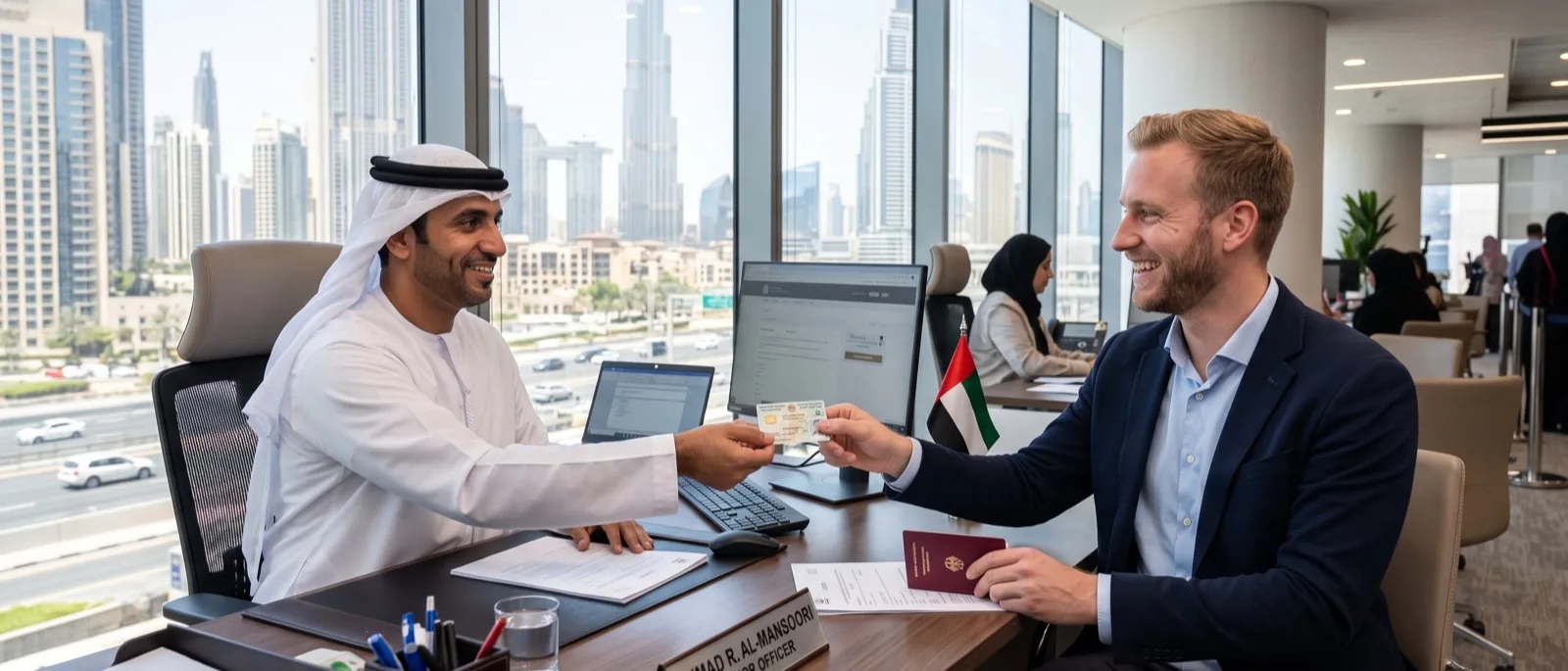
Checking the status of your Emirates ID
Once the application is running, the commonest question is: where is the card? You can check the status yourself at any time, through the ICP, the Federal Authority for Identity, Citizenship, Customs and Port Security. You need one of two numbers:
- Application Number (PRAN), a 15-digit number you receive when you file the application
- or your Emirates ID number, if the card has been issued before
The lookup runs via icp.gov.ae under ID Card Status. It shows whether the application is being processed, whether the card has been printed and whether it has already been handed to Emirates Post. Once printing is done you also get an SMS with the tracking number so you can follow delivery.
If the status stays unchanged for several days, it is almost always one of three usual reasons: the medical test has not been cleared, the biometrics are missing, or the delivery address on file is incomplete. All three can be sorted with one call to the ICP call centre (600 522222).
Duration
The entire process usually takes no longer than 3-4 working days on site if it is ideally planned and executed. If you are under time pressure or want the process to run smoothly, you should definitely hire a service provider to handle the process once. In particularly unfortunate cases, it has already been reported that it took several weeks, as some people try to do it themselves without any knowledge or experience.
In case of doubt, you can also leave the country after these 3-4 working days and arrange for the card to be sent to another person after it has been printed.
Emirates ID Renewal
The Emirates ID can be renewed without problems during or shortly before its expiry, as long as the visa is active. As a rule, this depends on the job, one's own company, or the investment through which the residence visa was obtained. The following is an overview of how long an Emirates ID is valid and when it needs to be renewed.
- Golden Visa: 10 Years
- Job / Company: 2 years
- Investor Visa: 2 Years
- Freelancer: 1 year
The process is essentially the same, except that you no longer have to undergo biometrics because your fingerprints are already stored in the system and do not change over the course of your life. The process is therefore as follows:
- Medical test
- Emirates ID Application
- Submission of documents
Precision pays off with the deadlines, because this is where it gets expensive fast. You can renew up to six months before expiry. After the expiry date you have 30 days, after which a late fee of 20 AED per day applies, capped at 1,000 AED. The clock runs whether or not you are in the country.
With an expired Emirates ID, banking, signing contracts and dealings with authorities no longer work, and the smart gates at the airport turn you away. If you leave the country and let the ID expire while away, you can only settle the late fee on your return; the clock keeps running regardless.
Loss, damage and replacement
If the card is lost or damaged, the rule is clear: report the loss within seven days to the ICP. The replacement application then goes through an ICP service centre or an approved typing centre; as a rule you do not have to give biometrics again, because the data is on file.
For the replacement card there is a card fee of around 300 AED plus about 70 AED in service charges, so roughly 370 AED or 95 € in total. If you are in a hurry you can add the express service; the card is then usually ready the next working day. Until the new card arrives, the digital proof through UAE PASS helps, and most places accept it.
UAE PASS: the digital Emirates ID
Something many expats discover late: attached to the Emirates ID is a digital identity, and it saves more time in daily life than the card itself. UAE PASS is the official digital ID of the Emirates, an app with which you log in to hundreds of government and business services, sign documents with legal effect and present your identity data digitally.
You set it up with a valid Emirates ID directly in the app, verified either by face recognition or once at a kiosk. After that it replaces the card for many procedures: applications to authorities, the tenancy contract through Ejari, business registrations, banking processes, even the digital driving licence runs through it. Anyone newly arrived should set up UAE PASS right after receiving the ID.
Quelle: uaepass.ae
Costs
The official fees for a two-year Emirates ID come to roughly 600 to 1,100 AED, about 150 to 280 euros, depending on whether you take the medical test as a standard or VIP service and whether you add express processing. Organising it yourself is possible but tedious: appointments and dealing with the authorities cost time and nerves. Handing the process over adds 500 to 1,000 euros, depending on the provider.
- Medical Exam: 750 AED
- Emirates ID (Application): 385 AED
- Biometrics: 1,000 AED
| Item | Cost |
|---|---|
| Medical check | 750 AED |
| Emirates ID (application) | 385 AED |
| Biometrics | 1,000 AED |
Official fees per the ICP, as of September 2026. Anyone handing the process to an agency pays a further 500 to 1,000 € for appointments, travel and dealings with the authorities; with us that is already included in the packages for Business Setup in Dubai . Further items: replacement card after loss around 370 AED, late renewal 20 AED per day up to a maximum of 1,000 AED.
Frequently asked questions
The questions we are asked most often about the Emirates ID.
How do I check the status of my Emirates ID?
Through the ICP at icp.gov.ae under ID Card Status, with your 15-digit application number (PRAN) or your Emirates ID number. It shows whether the application is being processed, the card printed or already handed to Emirates Post. After printing you also receive an SMS with the tracking number.
Is the Emirates ID the same as the visa?
No. The residence visa is the residence permit and since 2022 exists only electronically; the Emirates ID is the card with which you prove that residence in daily life. The two usually run for the same period but are issued by two authorities: in Dubai the visa by the GDRFA, the ID by the ICP.
What is on the Emirates ID?
Name, photo, nationality, date of birth, expiry date and the 15-digit identification number following the pattern 784-YYYY-XXXXXXX-X, plus a chip with the biometric data. The number is unique and stays with you for life, even after loss or a change of visa.
Can any nationality get an Emirates ID?
Yes. Nationality plays no part; what counts is a valid residence permit through a sponsor: your own company, an employer, a property or the Golden Visa. Anyone who gets a residence visa automatically gets an Emirates ID as well, one does not exist without the other.
What does the Emirates ID cost?
The card fee is 100 AED per year of validity, so 200 AED for a two-year ID. On top come service and processing fees plus the medical test, in total roughly 600 to 1,100 AED, so 150 to 280 €. The optional express service costs an extra 150 AED.
How long does it take for the Emirates ID to arrive?
On the ground, the sequence of medical test, biometrics and application takes three to four working days with good planning. The printed card then usually arrives within one to two weeks by Emirates Post. With the express service, issuance within 24 hours is possible.
What happens when the Emirates ID expires?
After the expiry date you have 30 days to renew. After that 20 AED per day falls due, up to a maximum of 1,000 AED. Until you renew, banking, signing contracts and the smart gates at the airport no longer work.
What should I do if I lose the Emirates ID?
Report the loss to the ICP within seven days and apply for the replacement card through a service centre or a typing centre. Biometrics are usually not needed again, because the data is on file. Cost: around 370 AED. Until the new card arrives, the digital proof through UAE PASS helps.
Do children need their own Emirates ID?
Yes, every family member with a residence visa needs their own card, newborns included. For children under 15 the fingerprint capture is dropped. The application runs through the sponsor, which as a rule means a parent.
Can I travel to other countries with the Emirates ID?
Within the GCC states, so far only nationals of the Gulf states travel on the ID instead of the passport; for expats it has been announced but not yet implemented. For all other travel you still need your passport. Within the UAE the ID replaces the passport practically everywhere.
Summary
The Emirates ID is sometimes the most important document when it comes to emigrating and living in Dubai. It is both an identity card and a key document and allows you to sign documents, conclude contracts, open accounts, buy/rent real estate and much more.
However, the basic requirement is a VISA sponsor. This can either be a company, a property or a family member (spouse).
However, the process should be well planned, otherwise it may take several weeks instead of a few working days.
Thinking about moving to Dubai?
Get our free Dubai relocation guide now: 7 tips on moving, company formation, visas & more.

You might also like