

Within a few years the UAE introduced two taxes that had not existed before: value added tax (VAT) in January 2018 and corporate tax in June 2023. Both are very low by international standards, but "low" is not the same as "irrelevant".
Because the taxes brought obligations that are routinely underestimated: registration with the Federal Tax Authority, filing deadlines, fixed mandatory details on every invoice and bookkeeping that holds up in an audit. Anyone who only tidies this up after the first financial year pays penalties higher than the tax itself.
This guide summarises what applies to a typical company in Dubai: Freezone as well as Mainland. It is meant as orientation and does not replace tax advice in an individual case.
- Corporate Tax: 9 % on taxable profit above AED 375,000, 0 % below that.
- Small Business Relief: no corporate tax up to AED 3,000,000 in revenue: applies to tax periods ending on or before 31 December 2029.
- Freezone: 0 % on Qualifying Income, provided the requirements for a Qualifying Freezone Person are met.
- VAT: 5 %, but only on supplies within the UAE. Registration is mandatory from AED 375,000 in taxable turnover.
- Foreign supplies: usually 0 % (zero-rated), which is not the same as exempt.
- Invoice to UAE customers: within 14 days of the supply at the latest.
- E-invoicing: mandatory for companies below AED 50 million in revenue from 1 July 2027, with a provider appointed by 31 March 2027.
The tax rates at a glance
Two taxes are normally relevant for a company in the UAE. Everything else (income tax, capital gains tax, inheritance tax, wealth tax) simply does not exist at private level.
Taxes for companies in the UAE
| Tax | Rate | Due from | Return |
|---|---|---|---|
| Corporate Tax | 9 % | Profit above AED 375,000 | Annually, within 9 months after the end of the tax period |
| Corporate Tax (Freezone) | 0 % | on Qualifying Income | Annually, audited accounts required |
| VAT (domestic) | 5 % | AED 375,000 in taxable turnover | Usually quarterly |
| VAT (export) | 0 % | Zero-rated, reporting obligation remains | Usually quarterly |
| Income tax | 0 % | – | No return |
| Capital gains, inheritance & wealth tax | 0 % | – | No return |
As of August 2026. The rates apply federally across all seven emirates. Separate rules apply to oil and gas companies and to branches of foreign banks.
Corporate Tax: 9 % on profit
A corporate tax has applied in the UAE since 1 June 2023. The rate is 9 %, but only on the portion of taxable profit above AED 375,000. Up to that threshold it is 0 %. The basis is the accounting profit, adjusted for the items named in the law.
Registration with the Federal Tax Authority is mandatory regardless: every company needs a corporate tax registration and files an annual return, even when that return comes to zero. The return is due within nine months after the end of the tax period. Missing the registration costs an AED 10,000 penalty.
Small Business Relief
There is relief for smaller companies. If your revenue did not exceed AED 3,000,000 in the current and in all previous tax periods, you can elect Small Business Relief and are then treated as having no taxable profit. No corporate tax is due. Converted, the threshold sits at roughly USD 800,000: for most one-person and consulting firms far above actual revenue.
Two things matter here. First, the relief is time-limited, but since August 2026 considerably less so: Ministerial Decision 131 of 2026 extended it to tax periods ending on or before 31 December 2029; previously it stopped at the end of 2026. Second, it is an election with a price, anyone who uses it cannot carry forward losses or claim interest deductions for the same period. In a loss-making year, forgoing it can therefore be the better decision.
What Small Business Relief does not spare you: the registration and the filing of the tax return.
Freezone: 0 % on Qualifying Income
Freezone companies can still pay 0 %, but not automatically and not on everything. The zero rate applies to a Qualifying Freezone Person and only to Qualifying Income: essentially business with other Freezone companies, with customers outside the UAE, plus a list of qualifying activities named in the law such as manufacturing goods, commodity trading, fund and wealth management or headquarter services for related parties.
This requires sufficient economic substance in the zone, audited annual accounts and compliance with transfer pricing rules. If non-qualifying income exceeds the permitted de minimis threshold, the company loses the status: for the current and the following four tax periods. Whether your activity qualifies therefore belongs settled before the first invoice, not after it.
More on the difference between the two structures in our comparison Mainland or Freezone.
Salary as a business expense
A salary paid to yourself reduces taxable profit, provided it matches what an unrelated person would receive for the same work. That is the arm’s length principle, and the Federal Tax Authority checks it. In practice, AED 60,000 to 80,000 a year is an order of magnitude that passes as market-standard for one-person companies. A salary equal to the entire annual profit is not.
Where the company is actually managed
The 9 % is the tax in the UAE, not necessarily the only tax on the same profit. If a UAE company is in fact managed from another country, that country may treat it as taxable there; what counts is the place of effective management, not the commercial register entry. The reverse holds too: the UAE treats a foreign company as resident here if it is effectively managed from the UAE.
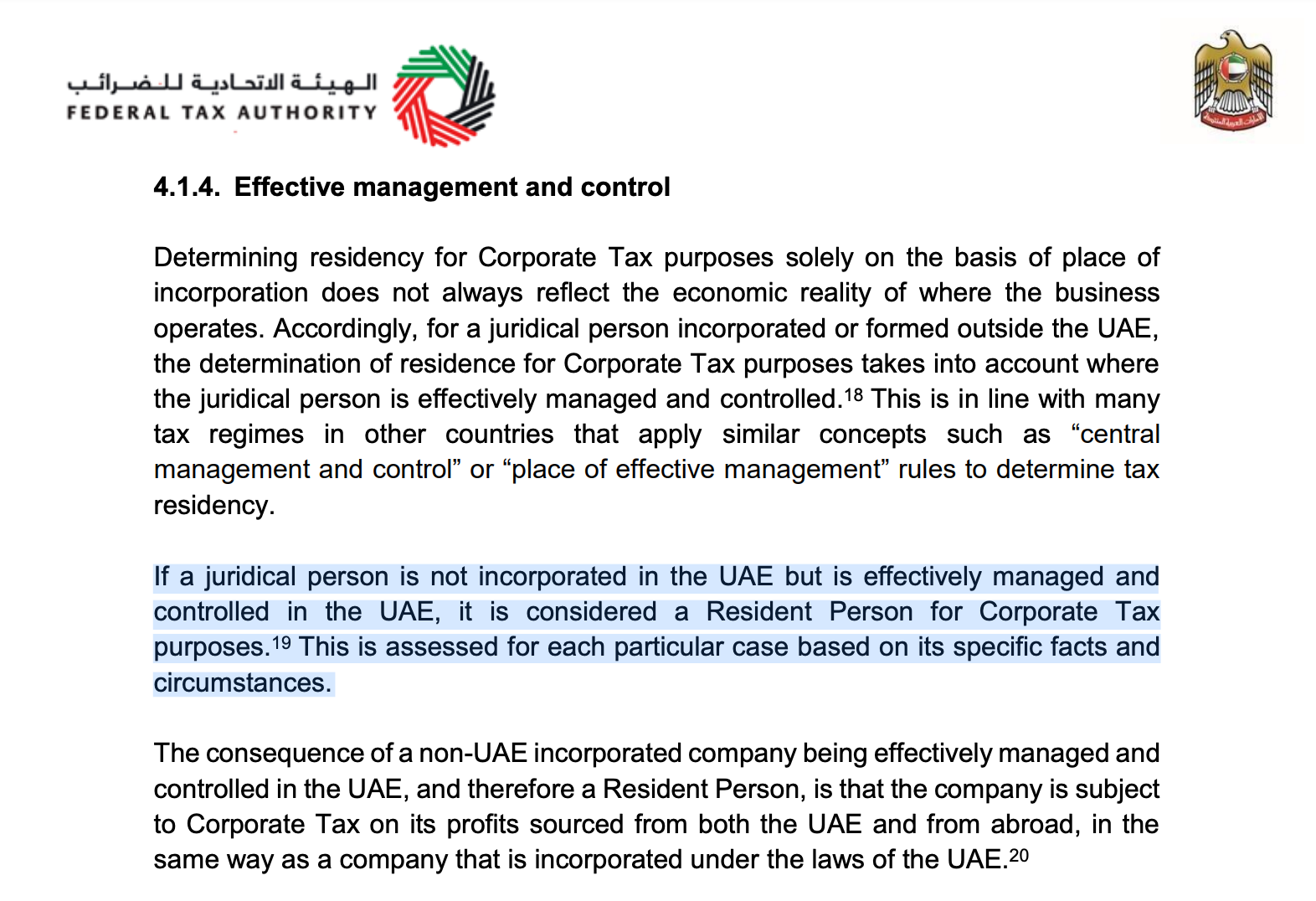
In practice that means: if your company is in Dubai, you should live and work in Dubai too. More on this in our article Dubai taxes.
VAT: 5 % on domestic supplies only
Value added tax is 5 % and only arises when you supply within the UAE, to private customers (B2C) just as to businesses (B2B). Freezones are not exempt from this: a Freezone company invoicing a customer in Dubai invoices with VAT.
Registration becomes mandatory once your taxable turnover has exceeded AED 375,000 over the past twelve months, or you expect it to do so within the next 30 days. Voluntary registration is possible from AED 187,500: worth considering if you want to recover substantial input VAT on investments.
Supplies to customers outside the UAE are normally invoiced at 0 %. This zero rate is not the same as a genuine exemption: zero-rated turnover counts towards the registration threshold and preserves input VAT recovery, whereas true exemptions, certain financial services or residential letting, for instance, do not. The difference decides whether you have to register and whether you get input VAT back.
Different rules apply to goods in the so-called Designated Zones; there, a supply between two zones can fall outside the scope of VAT. This exception does not apply to services.
An invoice to a UAE customer must be issued within 14 days of the supply. You normally file the VAT return quarterly; larger businesses file monthly.

VAT in the EU
A company in the UAE is not automatically outside European VAT. Two cases affect a large share of our clients:
- Digital services to private customers in the EU: online courses, software, subscriptions, digital downloads. VAT arises in the customer’s country of residence, and from the very first euro: the de minimis threshold only applies to suppliers established in the EU, not to third-country suppliers. This becomes manageable through an OSS registration under the non-Union scheme in a member state of your choice, through which you then report all EU countries.
- Physical products stored or manufactured in the EU: here a registration obligation normally arises in the country of storage, regardless of where the company is based. Fulfilment through a European warehouse triggers it.
If you want to avoid this, sell through a reseller such as Copecart or Digistore24. They act as the seller towards the end customer and take on VAT entirely; your UAE company then only invoices the platform, a B2B supply abroad, so 0 %.
If you sell exclusively to businesses in the EU the case is uncritical: the reverse charge mechanism applies and the customer owes the tax themselves.
Invoices: mandatory details
An invoice missing a mandatory detail gives your customer no input VAT deduction and, in case of doubt, is not a recognised business expense on your side either. The following details belong on every invoice your company issues:
Mandatory details on an invoice
| Detail | What it means |
|---|---|
| Full company name | The company exactly as it appears on the licence, no short form, no brand name |
| Address | The registered business address in the UAE |
| TRN | Your Tax Registration Number, once you are registered for VAT |
| VAT amount | 5 %, only if registered and supplying domestically: the amount must always additionally be shown in AED |
| Customer name and address | For registered UAE customers, their TRN as well |
| Sequential invoice number | Gapless and unique; each number may only be issued once |
| Invoice date | With VAT, also the date of supply where it differs |
The invoice itself may be denominated in any currency. Only the VAT amount must additionally appear in AED, converted at the published UAE Central Bank rate on the date of supply.
As long as you are not registered for VAT you do not show VAT either, tax shown without registration is still owed, and on top of that you risk a penalty.
Receipts and bookkeeping
All incoming invoices must be filed properly in the accounting software, not collected in a folder and handed over once a year. Every entry needs a supporting document, assigned and findable. This is the first place an audit looks.
The retention periods are long: records relevant to corporate tax must be kept for seven years after the end of the tax period, VAT records for five years, property records for fifteen years. In practice that means digital, complete and searchable: not in shoeboxes.
Above certain revenue thresholds, and for every Qualifying Freezone Person, audited annual accounts are additionally required. Anyone wanting to use the zero rate in the Freezone cannot avoid the audit.
Accounting software
We work with three systems. All three are established in the UAE, handle VAT correctly and can later be connected to an e-invoicing provider:
- Zoho Books: inexpensive, widely used in the UAE, with localised VAT handling. The obvious choice for most small companies.
- QuickBooks: internationally widespread, extensive interfaces, well suited when an external bookkeeper is involved.
- Xero: strong bank feeds and automation, pleasant with high transaction volumes.
Which system it becomes is secondary, that there is one at all is not. A spreadsheet does not meet the auditability requirements and cannot be connected to the coming e-invoicing regime.
We handle ongoing bookkeeping, corporate tax filing and the annual accounts in full on request: see Bookkeeping & Annual Accounts.
E-invoicing from 2026
The UAE is introducing a mandatory electronic invoicing system. Invoices will no longer be sent as PDFs by email but transmitted in structured form through an Accredited Service Provider (ASP) and reported to the tax authority at the same time, technically a Peppol-based five-corner model.
The rollout runs in phases. A pilot starts on 1 July 2026, after which it is staggered by revenue size:
E-invoicing rollout timeline
| Phase | Who is affected | Appoint ASP by | Mandatory from |
|---|---|---|---|
| Phase 1 | Revenue from AED 50 million | 30 October 2026 | 1 January 2027 |
| Phase 2 | Revenue below AED 50 million | 31 March 2027 | 1 July 2027 |
| Phase 3 | Government entities | 31 March 2027 | 1 October 2027 |
Source: UAE Ministry of Finance. The Phase 1 deadline was subsequently moved from 31 July to 30 October 2026; further adjustments are possible.
For the vast majority of our clients Phase 2 is the relevant one: provider appointed by 31 March 2027, mandatory from 1 July 2027. Anyone already booking in Zoho Books, QuickBooks or Xero does not have to change anything: the connection comes on top.
For our bookkeeping clients we take care of selecting the provider and connecting it well before the deadline. You do not have to deal with it.
Frequently asked questions
The questions we are asked most often about taxes in the UAE.
Do I have to pay corporate tax if my company turns over less than AED 3 million?
As a rule, no. With Small Business Relief your company is treated as having no taxable profit and no corporate tax is due. You do have to elect the relief actively in the tax return, and it applies to tax periods ending on or before 31 December 2029. Registration and the tax return remain mandatory in any case.
Do I need a VAT registration if all my customers are abroad?
Not necessarily, but you do have to check. Supplies to customers outside the UAE are usually invoiced at 0 %, yet these supplies count towards the AED 375,000 registration threshold. If you exceed it, you can apply for an exception from registration where all your supplies are zero-rated.
Does a Freezone company really pay 0 %?
Only under conditions. The zero rate applies to a Qualifying Freezone Person and only to Qualifying Income, essentially business with other Freezone companies, customers outside the UAE and a list of qualifying activities. It requires sufficient substance in the zone, audited annual accounts and compliance with transfer pricing rules. Without these, the regular 9 % applies.
What currency do my invoices have to be in?
The invoice itself may be in any currency: euro, US dollar, Swiss franc. If you show VAT, the tax amount must additionally be stated in AED, converted at the published UAE Central Bank rate on the date of supply.
What happens if I miss the corporate tax registration?
The Federal Tax Authority imposes a penalty of AED 10,000 for this. Further penalties are added if the tax return is not filed on time. Registration is due even when the company makes no profit or falls under Small Business Relief.
Do I need to deal with e-invoicing already?
For companies with less than AED 50 million in revenue the obligation starts on 1 July 2027, and the provider must be appointed by 31 March 2027. What matters most is that your bookkeeping runs in a system that can be connected. For our bookkeeping clients we handle selection and connection.
Summary
The UAE remains exceptionally attractive from a tax perspective: at private level there is still no tax at all, and for companies the top rate is 9 %, which many never reach thanks to Small Business Relief or the Freezone zero rate. The effort has shifted nonetheless, not in the tax burden, but in the documentation.
Anyone who registers properly from the start, invoices correctly and files receipts continuously in a real accounting system has little work with all of this. Anyone who puts it off pays penalties for things that would have cost nothing in substance.
As of August 2026. This guide is general orientation, not tax advice for an individual case. Rules and deadlines can change; we will review your specific situation together.
Thinking of moving to Dubai?
Then get our free Dubai relocation guide with 7 tips on moving, company formation, visas and more.