
More and more people are emigrating to Dubai. Emigration is a major project and an important part of this is health and medical insurance. The insurance system in the United Arab Emirates is very different from that in most European countries.
This guide explains everything you need to consider when emigrating to Dubai with regard to health insurance.
- There are two types of insurance in Dubai. Local health insurance policies and international health insurance policies. The latter are slightly more expensive, but more popular among expats who travel a lot and are also recommended.
- Anyone who moves to Dubai and is self-employed must take out insurance. Otherwise, the employer generally takes care of the mandatory insurance.
- The most popular international health insurances include sometimes Genki, Passport Card, Foyer and April.
- The costs vary greatly and depend on one's medical history, age, and desired scope of coverage.
- At the election one should carefully consider which insurance suits oneself and, in case of doubt, also get advice.
Do I need health insurance?
Yes, and it is compulsory. There is no state-run solidarity system as in Europe, but since the Dubai Health Insurance Law No. 11 of 2013 every resident is legally required to be insured. It is enforced where it hurts: without a valid policy the authority will not issue or renew a residence visa.
Regardless of the legal requirements, you should take out health insurance. In the event of illness, this will cover the costs. Otherwise, you will have to pay the entire costs yourself privately. Depending on which health insurance you take out, you will receive different levels of benefits and the sum insured is also variable.
The obligation applies to every resident holding a residence visa, regardless of age and nationality, and it hangs on a sponsor: employers insure their staff, and at their own expense, because the law expressly forbids deducting the premium from wages. Anyone living in Dubai through their own company is employer and insured person at once and has to insure themselves. For family members who come along, the respective sponsor is responsible, which as a rule means you.
The statutory minimum is the Essential Benefits Plan (EBP), a basic plan defined by the Dubai Health Authority for low earners. It covers emergencies, basic care, pregnancy and a limited number of examinations and costs roughly 600 to 800 AED a year depending on age, so about 150 to 200 €. For anything beyond that, free choice of doctor, good clinics, dental treatment, treatment abroad, you need a proper plan.
Without a valid policy the residence visa is neither issued nor renewed, the process simply stalls. On top come fines, in Dubai usually 500 AED per month and uninsured person. For employers who fail to insure their staff, the rates are considerably higher.
Since 1 January 2025 the obligation no longer applies only in Dubai and Abu Dhabi but, through the Basic Health Insurance Scheme, nationwide, so also in Sharjah, Ajman, Ras Al Khaimah, Umm Al Quwain and Fujairah. The basic plan there starts at around 320 AED a year and covers up to 50,000 AED in-patient and 10,000 AED out-patient.
Sources: dubai.gov.ae: Law No. 11 of 2013, dha.gov.ae, mohap.gov.ae
How the healthcare system in Dubai works
Anyone arriving from Europe first has to drop a habit of thought: in the UAE there is no health fund settling bills in the background and no contribution taken as a percentage of income. There are insurers, plans and networks, and the plan decides which clinics are open to you.
Who regulates what
In Dubai the authority is the Dubai Health Authority (DHA), in Abu Dhabi the Department of Health, and for the remaining emirates the health ministry MOHAP. The DHA sets the minimum scope, licenses insurers and clinics and runs the platform on which policies and claims are checked.
Public and private
Public hospitals such as Rashid Hospital, Dubai Hospital or Latifa Hospital for women and children are well equipped but aimed primarily at nationals; without suitable insurance expats pay out of pocket there. For most expats daily life plays out in the private chains: Mediclinic, Aster, NMC, Saudi German Hospital and the American Hospital Dubai. The standard is high, the equipment modern, waiting is rare, and several of them have doctors who speak German.
The network matters more than the sum insured
The decisive difference between two plans is rarely the sum insured, it is the network. Cheap plans tie you to a small network, often without the premium hospitals; more expensive plans open every chain and also reimburse outside it. If you already know which clinic you want, check before signing whether it is in the network: that matters more than a sum you will never exhaust anyway.
Providers compared
The number of providers is large, but here is an overview of the best-known and most popular providers of health insurance in Dubai.
Local providers
On insurancemarket.ae you will find a large number of local insurance providers. These are mostly limited to the UAE and the GCC region. If you need local health insurance, you will definitely find it here and these providers are usually the cheapest. After briefly entering the most important data, you will receive various offers from GIG, Sukoon or other providers.
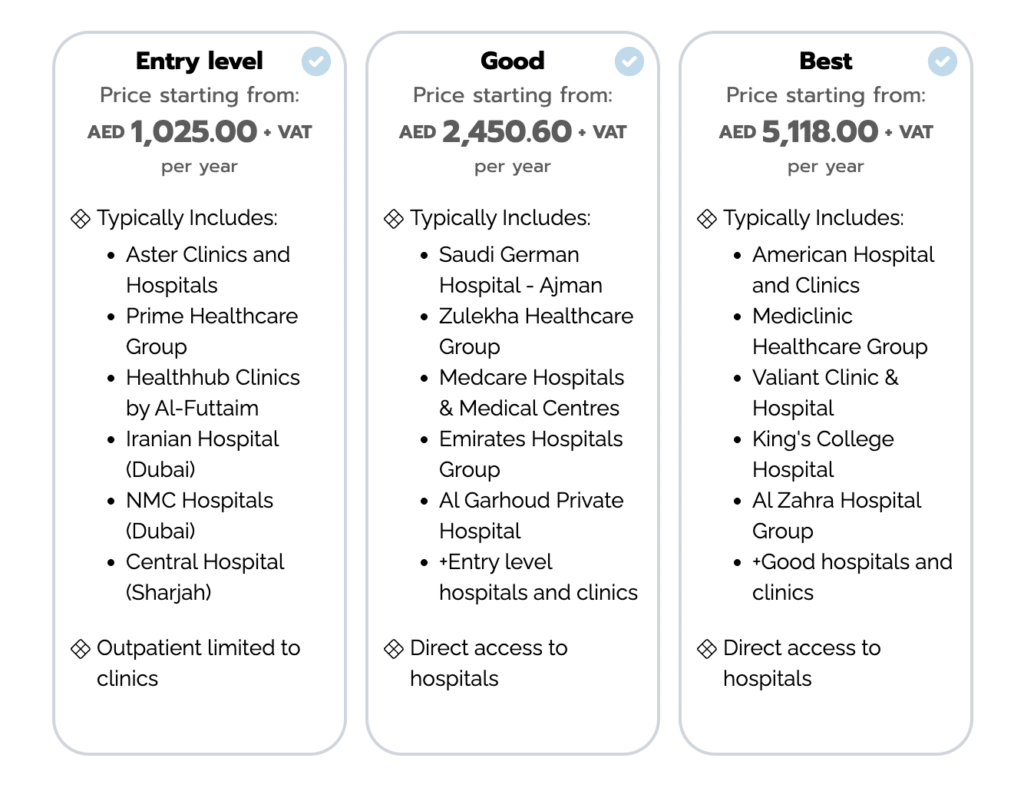
Usually, you can choose from different hospital packages here. This is because there are also different “hospital chains” here, which have correspondingly different service and quality standards. Here is a brief overview of the most important offers divided into packages.
As you can see here (we can also confirm this), the best local hospitals are definitely American Hospital, Mediclinic and King's College Hospital. These can be found in the Best Package for around AED 5,000, i.e. €1200 per year. However, the price refers to an example of a healthy man around 30 years old. The exact prices logically vary from person to person, more on this later.
International providers
However, if you generally travel a lot and want to enjoy a high level of insurance cover abroad, you should take out the following insurance policies. These are among the most popular among expats from Europe and have proven their worth in recent years.
There is no single best option; you should get a quote from each of the four providers below based on your individual preferences.
PassportCard
The PassportCard has been popular with digital nomads and expats in Dubai for many years. This insurance product is provided by Allianz Insurance from Germany and offers attractive insurance packages for various geographical zones.

The idea behind it is that, in the event of illness, the card can be topped up via the app and then used in hospital. This means you don't have to advance any costs yourself, but can pay directly with the card. Alternatively, you can of course pay yourself and then have the costs reimbursed if you wish.
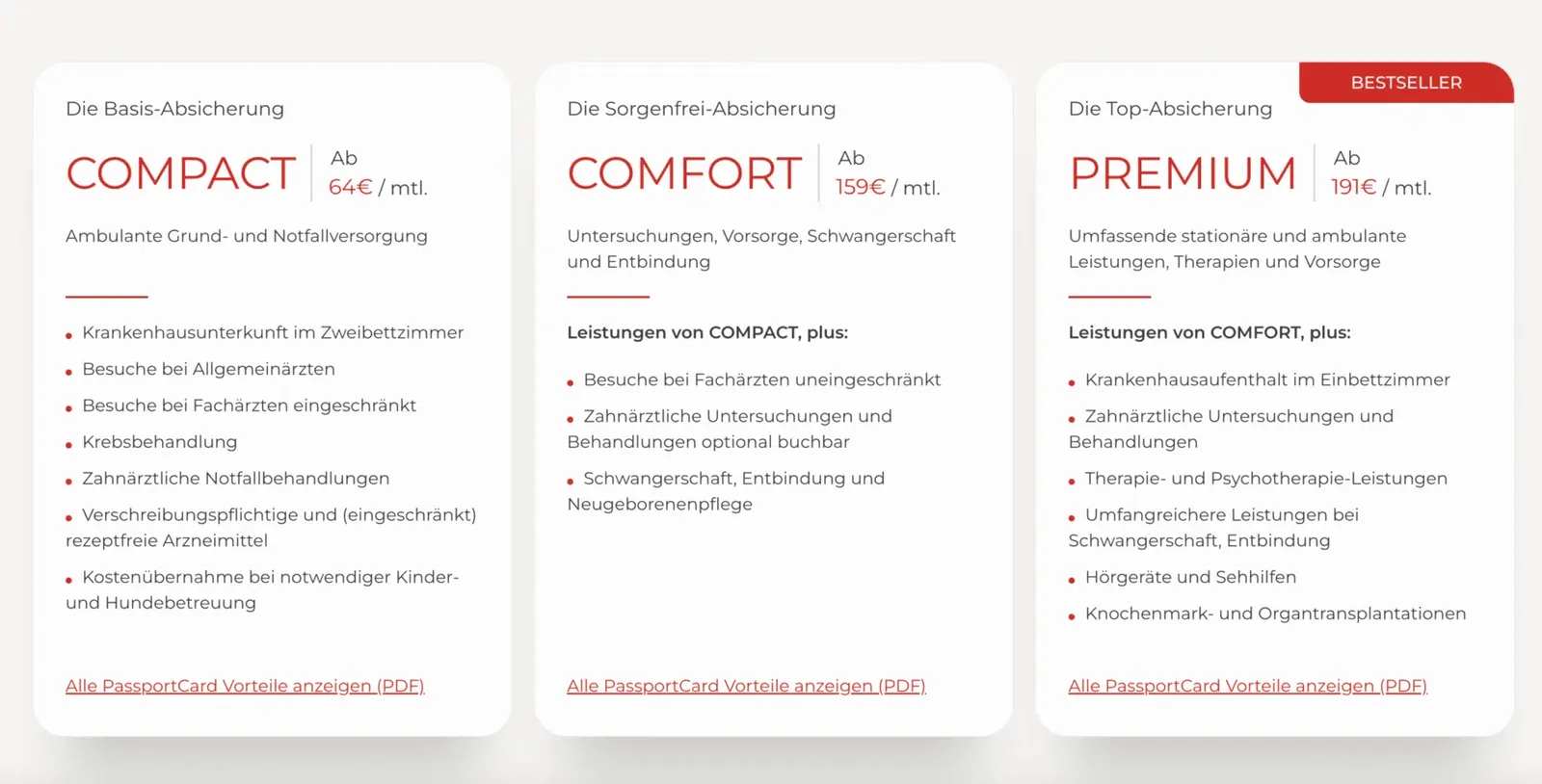
Basically, the benefits are divided into 3 plans. As already mentioned, the costs are individual. However, here is a brief overview.
The complete performance table can be found here.
One of the biggest advantages, apart from the attractive packages, services and the app with card, is of course the German-speaking support. If you want German quality, you will find it at Passport Card and you will definitely feel more comfortable abroad if you know that the insurance company and its employees speak the same language.
Genki
Genki is another German insurer or insurance broker that has launched a great package for digital nomads and frequent travelers. The offer is very clearly understandable, making the decision relatively easy.
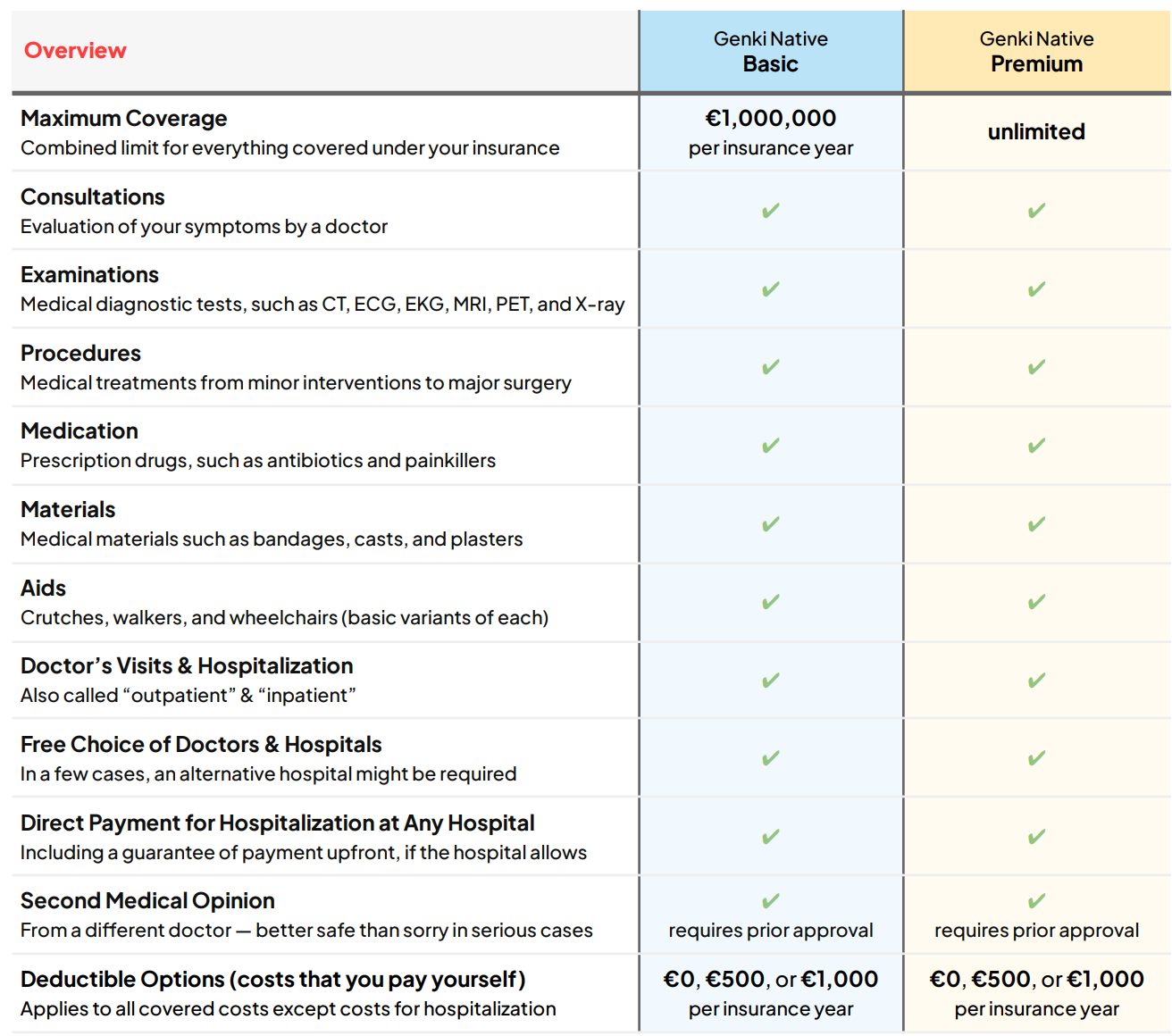
There is a basic package, on the one hand, which provides all-around insurance worldwide and covers you for travel and living abroad. The price for most is under €200.
In addition, there is the Premium package, which includes everything from the Basic package but also covers preventive and alternative medicine expenses. Below is a brief comparison of both packages.
The advantage of Genki lies simply in the straightforwardness of its offerings. Generally, you are fully insured worldwide and can additionally utilize preventive and alternative medicine services via the Premium package.
Additionally, the insurance is slightly cheaper than the Passport Card.
Foyer (Global)
Another interesting provider is Foyer Global. The insurance company from Luxembourg offers international health insurance for expats of all kinds. Here, too, you get attractive plans with a modern infrastructure.
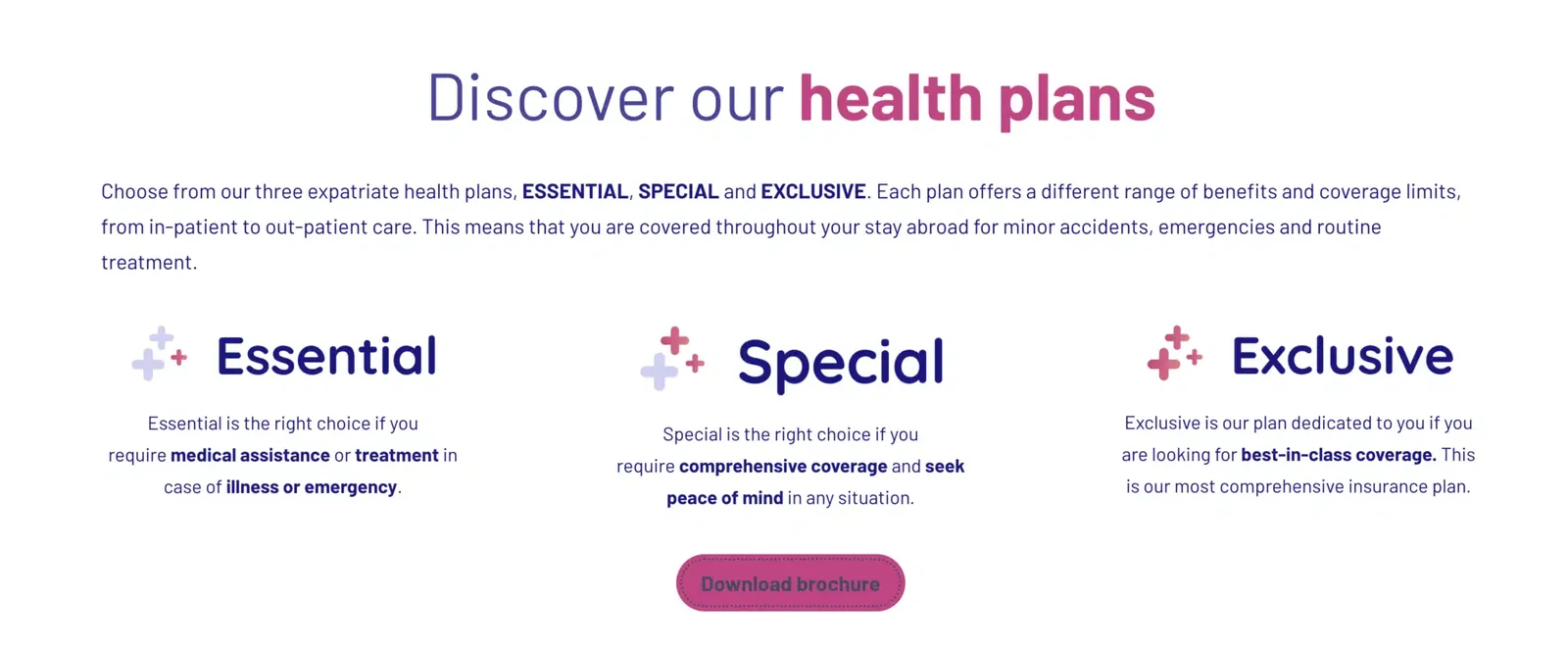
Just like PassportCard, there are 3 plans to choose from. The exact details can be found here.
April (International)
A French provider that has become so popular in recent years due to its low monthly insurance costs is April. This provider is slightly cheaper and you can choose between 4 different basic packages.
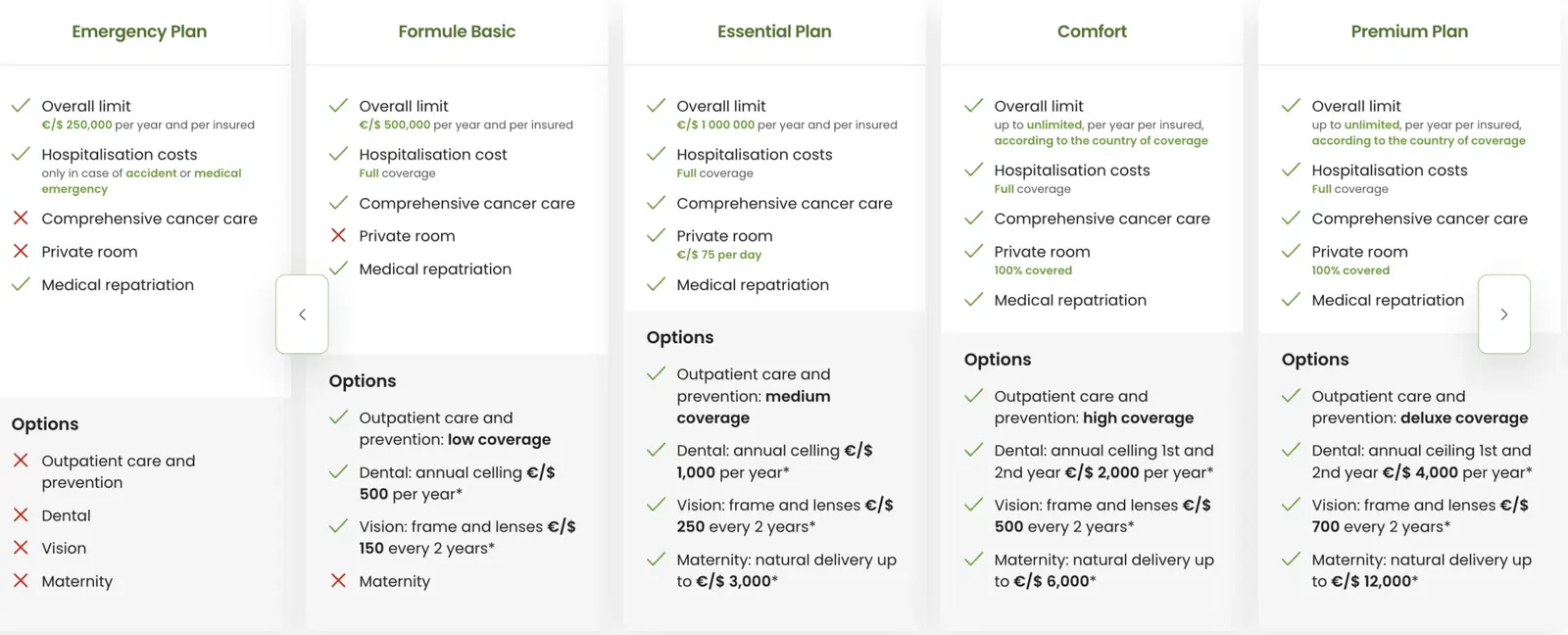
The exact details of the plans can be found in the brochure here.
The main options side by side:
| Provider | Cover | Typically for | Premium / year |
|---|---|---|---|
| Essential Benefits Planstatutory basic plan | UAE only, small network | employees on low pay, bare compliance | approx. 600 – 800 AED150 – 200 € |
| Local insurersGIG, Sukoon, Daman, Orient | UAE, partly GCC | those living in Dubai permanently who rarely travel | 1.000 – 4.000 € |
| PassportCardthrough Allianz Partners | worldwide, direct payment by card | expats who do not want to advance the bills | 1.500 – 3.500 € |
| Cigna Global | worldwide, modular | those who travel a lot and want to combine freely | 2.000 – 5.000 € |
| Allianz Care / BDAE | worldwide, German-language service | families and anyone wanting German-speaking contacts | 2.000 – 5.000 € |
Indicative figures for a healthy person of middle age, as of September 2026. The actual premium depends on age, pre-existing conditions, excess and network; only the personal quote is binding. Our team is insured through PassportCard because treatment is paid directly by card there instead of paying up front and claiming later.
Costs
The cost of health insurance is impossible to say in general terms, as it always depends from person to person. The biggest factors that determine how high the monthly insurance premium is always are:

- Gender
- Age
- Previous illnesses / history
- Scope of insurance (benefits)
- Insurance amount (maximum costs covered per year)
Of course, you can't choose the first 3 factors yourself, but the last 2 are variable and depend on your own needs. If you travel a lot, you should generally always take out international health insurance. This allows you to go to the doctor and receive treatment in a wide variety of countries.
Anyone who also fears the worst or would like to be covered should also consider increasing the insurance benefits. Extra services that are usually not included in the standard packages include
- Dentist
- Physiotherapy
- Psychotherapy
- Massages
- Single room in hospital
- Loss of earnings insurance in the event of illness
You can add or remove these extra points yourself or they are included in various insurance packages offered by providers. They are not necessary, but can make sense in certain cases.
Even so, orders of magnitude can be given. The figures below are what we see in practice for a solid plan with a good clinic network:
| Situation | Local plan | International plan |
|---|---|---|
| Single person, 20 – 35 years | 1.000 – 2.000 € | 1.500 – 2.500 € |
| Single person, 36 – 50 years | 1.500 – 3.000 € | 2.000 – 3.500 € |
| Single person, 50 years and up | 2.500 – 5.000 € | 3.500 – 7.000 € |
| Couple, both under 40 | 2.000 – 4.000 € | 3.000 – 5.500 € |
| Family with two children | 3.500 – 7.000 € | 5.000 – 10.000 € |
| Statutory minimum (EBP) | approx. 150 – 200 € per person | |
Annual premiums in euros, as of September 2026, rounded. The price drivers, in this order: age, pre-existing conditions, the size of the clinic network and whether dental and maternity are included. An excess of 10 to 20 % lowers the premium noticeably. What the rest of life in Dubai costs is in the article Cost of living in Dubai.
Travel cover, expat plan and your insurer back home
Two things get confused again and again, and the confusion can be expensive.
Travel health insurance
It applies to holidays, usually up to 42 or 56 days at a stretch, costs 10 to 40 € a year and covers acute emergencies plus repatriation. For a holiday in Dubai it is entirely sufficient, and while it is not required for entry as a tourist it is strongly recommended. As proof for a residence visa it is not accepted: the authority requires a policy licensed in the UAE that meets the DHA minimum scope.
Expat or international health insurance
It is designed for living abroad permanently, has no time limit, covers preventive care and chronic treatment and meets the requirements for the visa. That is exactly what you need when you emigrate.
What happens to your statutory cover at home
Deregistering and giving up your residence ends compulsory membership of statutory health insurance, and the UAE has no social security agreement with most European countries. Two things are worth doing first: written cancellation with proof of the foreign policy, otherwise contributions keep running. And second, the dormancy cover, which secures your re-entry without a fresh health assessment if you come back later; depending on the insurer and the model it usually costs between 15 and 60 € a month. Those with private cover should agree the same with their insurer, where it is called a suspension agreement. Anyone planning the move will find the full sequence in the guide Moving to Dubai.
Experience
In our experience, taking out health insurance when emigrating to Dubai is definitely worthwhile. If you want to save money, you can use a local provider, but we clearly recommend an international provider that covers a variety of countries. Our team is fully familiar with Genki insured by Allianz Insurance from Germany.
Recommendation: Professional advice
Insurance should be chosen carefully, because in an emergency, you should be adequately insured. If you are unsure or do not have time to compare all insurance policies in detail, you should book professional advice.
Our insurance partner Insurance Offers free, professional advice for health insurance in Dubai and beyond.
Frequently asked questions
The questions we are asked most often about health insurance in Dubai.
How much does health insurance in Dubai cost?
The statutory basic plan (Essential Benefits Plan) runs at around 600 to 800 AED a year, so about 150 to 200 €. A solid plan with a good clinic network costs a single person between 1,000 and 3,000 € a year, with international cover rather 1,500 to 3,500 €. For a family with two children reckon on 3,500 to 10,000 €.
Is health insurance in Dubai mandatory?
Yes. Under the Dubai Health Insurance Law No. 11 of 2013 every resident must be insured, and since January 2025 the obligation also applies in the northern emirates through the Basic Health Insurance Scheme. Without a valid policy no residence visa is issued or renewed, and fines start at 500 AED a month.
Am I covered as a tourist in Dubai?
No, not automatically. For a holiday an ordinary travel health policy with repatriation is enough, costing 10 to 40 € a year. Without insurance you pay privately, and private clinics in Dubai are expensive: an emergency visit can quickly reach four figures.
Does my employer pay for health insurance?
In the UAE the employer is legally obliged to insure their staff and may not deduct the premium from wages. For spouses and children they are not responsible, however: that falls to the respective sponsor, which as a rule means you.
What is the healthcare system in Dubai like?
There is no health fund in the European sense, only insurers and plans. It is regulated by the Dubai Health Authority. Day-to-day care takes place in private chains such as Mediclinic, Aster, NMC or the American Hospital; the standard is high and waiting times are short. Which hospitals are open to you depends on your plan's network.
Can I keep my statutory health insurance at home?
Deregistering ends compulsory membership, and there is no social security agreement between the UAE and most European countries. Dormancy cover makes sense: it secures your re-entry without a fresh health assessment if you return later and usually costs 15 to 60 € a month.
Is travel health insurance accepted for the visa?
No. For the residence visa the authority requires a policy licensed in the UAE that meets the DHA minimum scope. A European travel policy does not, however good it may be.
Are pre-existing conditions covered?
Not automatically. Local plans often exclude pre-existing conditions or impose waiting periods of six to twelve months; international providers usually include them against a surcharge. Anyone with something to declare should do so openly: a concealed condition costs you the cover when it matters.
Is dental treatment included?
Not in the basic plan; in better plans usually as a module against a surcharge. Dental work in Dubai is comparatively expensive, so the module is worth it for most people. The same goes for maternity: the Essential Benefits Plan covers it only to a limited extent and it should be deliberately included if you are planning children.
Summary
In summary, it can be said that you should definitely take out health insurance when emigrating to Dubai. On the one hand, because this is required by law, on the other hand, because you are insured in case of illness and private hospitals are usually very expensive.
However, everyone must evaluate individually which insurance they need.
Thinking about moving to Dubai?
Get our free Dubai relocation guide now: 7 tips on moving, company formation, visas & more.

You might also like