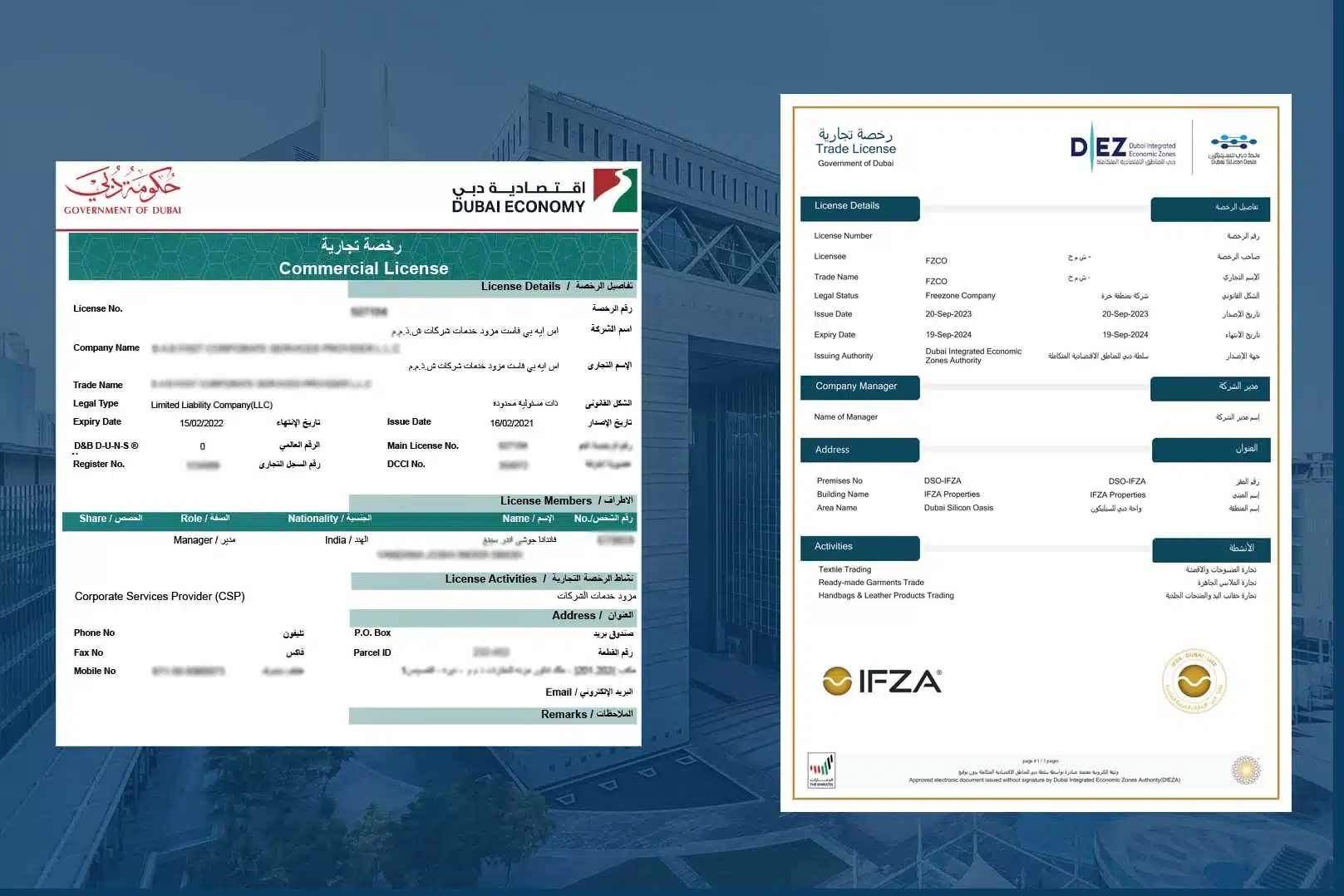

Dubai has been a popular tax haven for expats from all over the world for years. High-tax countries such as the UK, France, Germany, Italy and Austria in particular lose thousands of wealthy people to the metropolis on the Arabian Gulf every year.
But what taxes are there in Dubai and how attractive are they really in an international comparison?
This comprehensive guide details all the taxes in Dubai and explains why they are so attractive, so many people come to Dubai primarily for the taxes. Emigrate to Dubai.
All taxes in Dubai at a glance
The fact that there are absolutely no taxes in Dubai is a myth and has not been the case for a long time. Nevertheless, the tax advantages are enormous, especially for certain people. Here is an overview of all the most important taxes and tax categories and their rates.
Private
At a private level, you are still completely tax-exempt as long as you do not carry out any commercial activities. Therefore, income from a job through salary and other income is still tax-free.
Income
The income you receive from your job as a salary is tax-free without limits. There are also no additional social security contributions, as is the case in many other countries. Gross is therefore always net when it comes to salary.
However, if you are now self-employed and run a company, this salary must not be infinitely large. For example, if a company has a turnover of USD 1 million and the expected profit is USD 800,000, the salary must not correspond to the amount of the profit and erode it.
This is based on American tax law and is referred to as an arm's length, i.e. a standard that is customary in the industry. This means that the salary of an entrepreneur must also be customary in the industry and in a healthy relationship to turnover.
Investment income
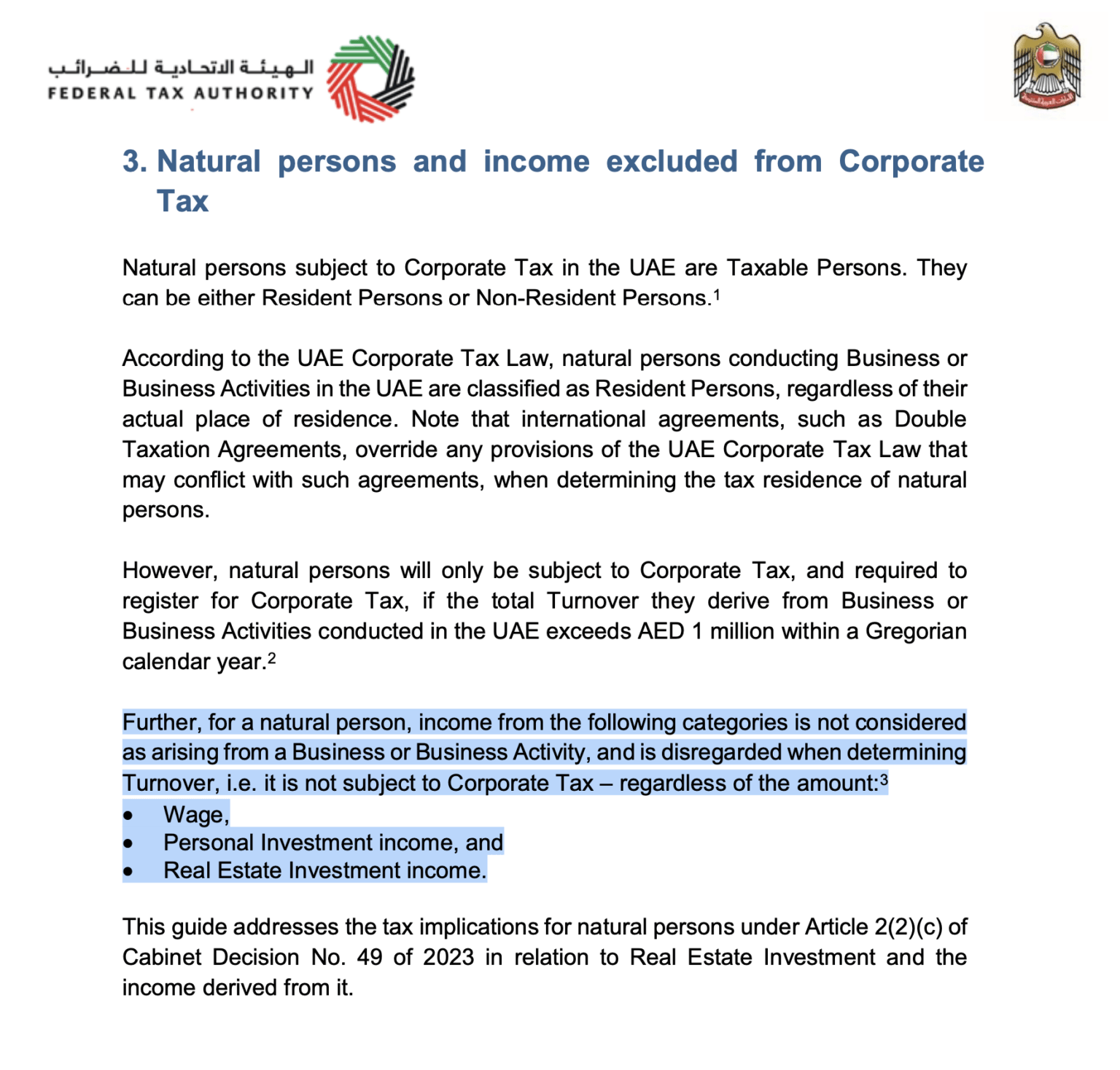
Capital gains from shares, ETFs, interest or similar are still exempt from tax without limit. This is why Dubai is particularly popular with investors. However, this also applies to active traders, i.e. trading is still not subject to taxation as long as it is done exclusively for oneself. This makes Dubai very different from other tax havens that do not tax passive capital gains but do tax active trading or investment (e.g. Switzerland).
Crypto
Tax-exempt capital gains also include cryptocurrencies. Dubai has now become a veritable hub for numerous blockchain companies and investors. There are still no taxes on crypto profits.

Dividends
Dividends received from shareholdings in companies are also completely tax-free. This means that distributions from dividend shares, but also from shareholdings in companies, are exempt from any tax.
Real estate & Airbnb
Real estate is generally tax-exempt in Dubai as long as it is not used for short-term rentals on a large scale, similar to a hotel. In practice, you can therefore buy as many apartments as you like and the rental income from them is tax-free without limit.

However, for short-term rentals via Airbnb or booking.com, a license from the Dubai Department of Economy and Tourism is required. Up to 8 residential units require the so-called Holiday Home Permit. If it's more than that, a mainland company with the “Vacation Home Rental” license is needed.
There is also no annual property tax, as in many other countries.
There is only a 4 % fee for the Dubai Land Department at the time of purchase. This is known as the DLD fee.
Inheritance, gift & wealth tax
Another reason why so many wealthy people move to Dubai is that there are no taxes on inheritance, gifts and assets. Germany is once again talking about introducing a wealth tax and Switzerland still has one. Inheritance and gifts are still taxed in many countries around the world.
In Dubai, the transfer of assets of all kinds is not taxed.
The company
For a very long time, companies in Dubai were completely exempt from tax. However, times have changed. Since 2023, there has been a so-called corporate tax. This is generally 9% and taxes the profits of companies.
In practice, however, there are several points that influence or exclude this.
Small Business Relief
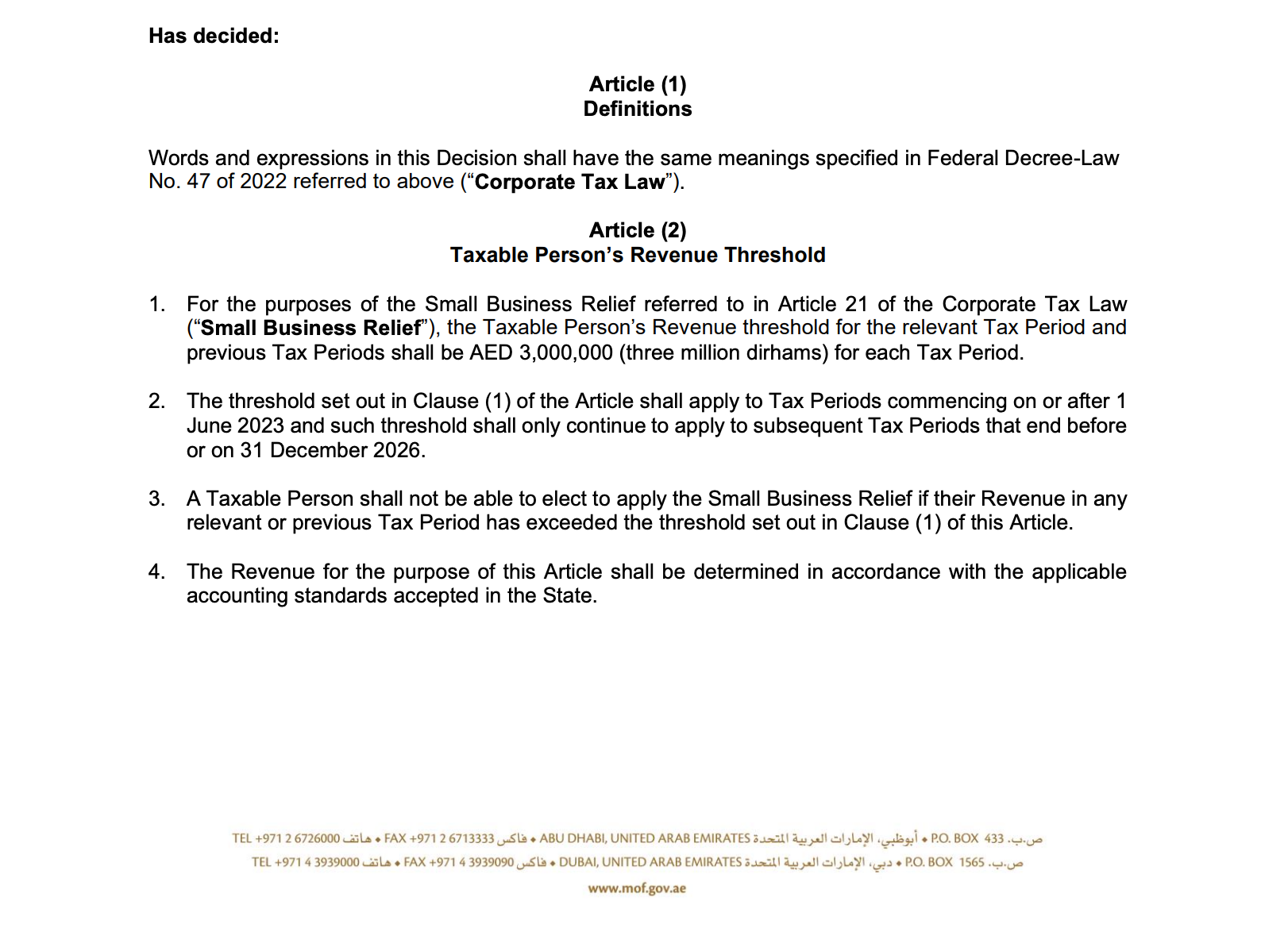
Companies with a turnover of less than AED 3 million are still exempt from tax. Converted, this is approximately USD 800,000 that can still be turned over tax-free as a company. Profits are also not taxed as long as turnover does not exceed this limit.
Qualified Income / Activities
There is still a complete tax exemption without a limit for certain companies or business activities that are carried out in free zones. These activities are known as qualified activities and may only be carried out in free zones. These include the following activities, among others:
- Manufacture of goods or materials. b. Processing of goods or materials.
- Trade in qualified raw materials.
- Holding shares and other securities for investment purposes.
- Ownership, management and operation of ships.
- Reinsurance services.
- Fund administration services. h. Asset and investment management services.
- Head office services for related parties. j. Treasury and financing services for related parties.
- Financing and leasing of aircraft.
- Distribution of goods or materials to or from a particular zone.
- Logistics services.
375,000 AED allowance
In addition, regardless of turnover, there is an allowance of around AED 375,000, the equivalent of over USD 100,000, which does not have to be taxed. No matter how high the company's turnover or profit is, this allowance is de facto not taxable.
VAT
Since 2018, there has been a VAT of 5% in the UAE. This tax applies to the sale of products and services sold within the UAE. At the same time, companies can reclaim this VAT when purchasing products and services from other companies.
For companies, this is only mandatory if VAT-liable turnover is more than AED 375,000. Below this amount, you do not have to register or pay VAT. A so-called VAT Exempt is applied.
Real estate is generally exempt from VAT, unless it is commercial real estate.
Anyone who buys goods abroad and imports them into the UAE as a resident usually has to pay customs duty in addition to VAT. This is also 5% and therefore the duty is around 10% on most imported goods.
Source: https://mof.gov.ae/vat/
Tax trap: offshore company (e.g. US LLC)
The myth that entrepreneurs can relatively easily avoid the 9 % corporation tax in the UAE by setting up an offshore company in a tax haven with 0% keeps circulating. The USA with the US LLC is particularly popular.
However, this is a tax trap, as offshore companies that were founded abroad on paper but are effectively managed from Dubai or the UAE are also subject to tax laws here.
This is relatively clearly regulated and is also protected by the OECD standard, which bases the company's registered office and tax domicile on the place of management. The technical term is Place of Effective Management.
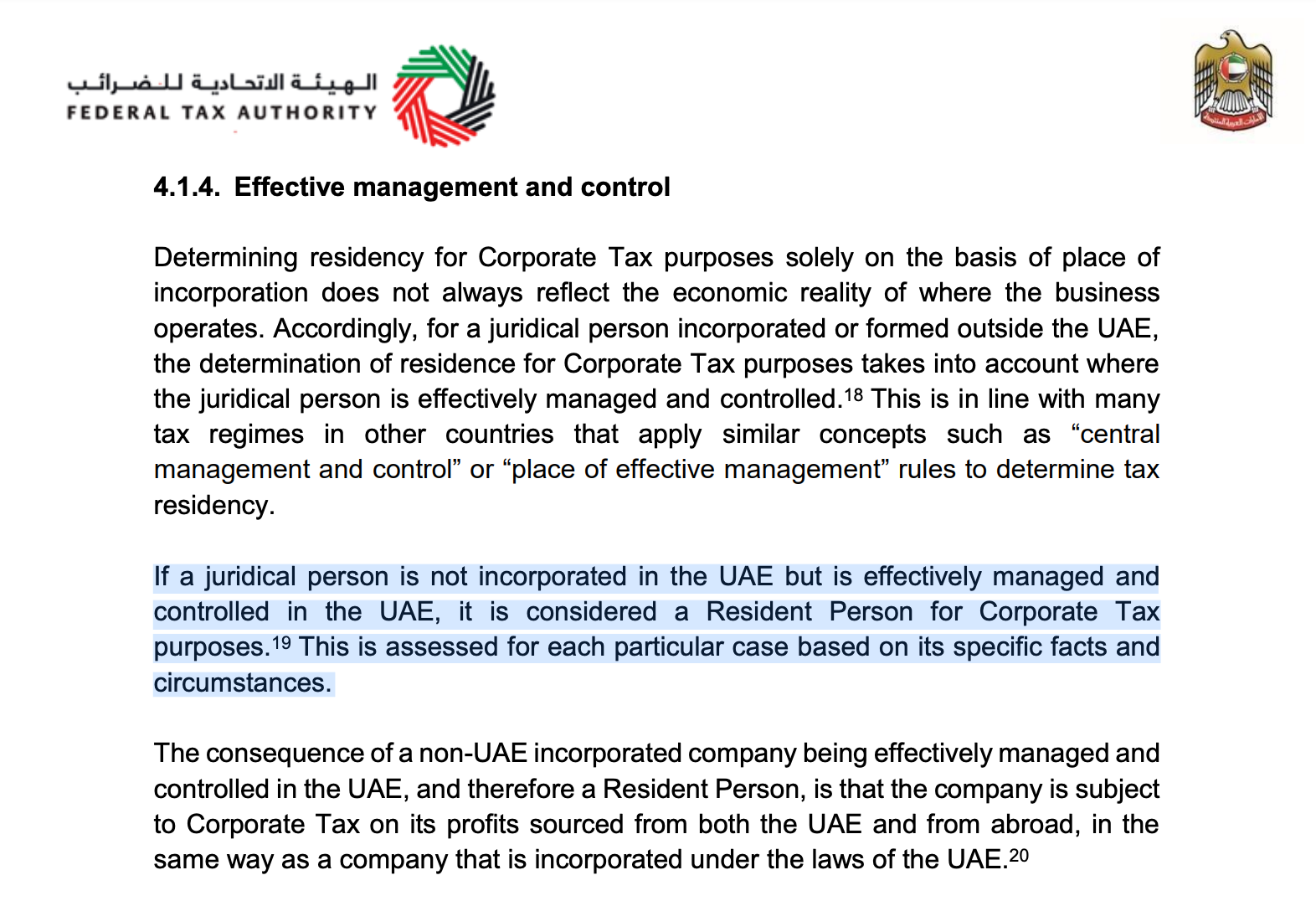
This is also clearly stated in the excerpt of the legal text for corporate tax law in the UAE. It is therefore not a gray area or loophole, as some call it, but rather clear tax evasion.
Tax calculator
When we compare the tax system of Dubai or the UAE with that of numerous European countries, a clear picture emerges. Dubai is significantly more business-friendly than all European countries, even more so than Monaco.
The tax system already offers significant advantages for small business owners and self-employed individuals. Below is a tax calculator based on current tax laws for calculating taxes on various incomes in the UAE.
Dubai Setup · UAE
Estimate your tax burden as an expat in Dubai (UAE)—individuals pay 0% income tax; only corporate income tax is relevant.
No income tax for individuals in the UAE. Note: Freelancers/sole proprietors will only be subject to corporate tax from AED 1 million in UAE business turnover (see below).
Mainland: 0% for profits up to 375,000 AED, 9% for amounts above that. Free Zone (QFZP, top bracket): 0% on qualifying income; non-qualifying / Mainland income 9%. DMTT 15% only for large corporations (≥ €750 million).
Dividends paid to individuals in the UAE are tax-free, both locally and internationally (potential withholding tax abroad is not considered).
Private crypto profits are tax-free for individuals. Commercial trading as a business may be subject to corporate tax.
Capital gains from private investments (stocks, real estate in private assets) are tax-free in the UAE.
Effective tax rate
Note: Non-binding estimate based on current UAE tax laws (as of 2026). Individuals pay 0% income tax as well as 0% on dividends, capital gains, and personal crypto gains; there is no wealth tax or inheritance tax. Corporate income tax: 0% on profits up to 375,000 AED, 9% thereover; Free Zone (QFZP) 0% on qualifying income (net worth requirements); Small Business Relief 0% for revenue ≤ 3 million AED through the end of 2026; DMTT 15% applies only to large corporations (≥ 750 million €). VAT 5% is levied separately. This calculation replaces no individual tax advice. QFZP conditions, substance, DBA, and special cases are not depicted. Please book a consultation for a binding assessment.
Frequently asked questions
Below are the most frequently asked questions and answers regarding taxes in Dubai.
Are crypto & trading gains still tax-free?
Yes, profits from crypto and trading remain tax-free. Thus, Dubai and the UAE are an optimal location for traders and investors.
Can I start a company in Dubai and live in Germany to save on taxes?
From a tax perspective, this is generally not possible, as the place of effective management would continue to remain in Germany.
One would need to demonstrate a managing director and actual activities on the ground in Dubai for the tax residency in Dubai to be actually recognized.
Do I pay taxes on rental income from Dubai real estate?
Dubai itself does not impose taxes on rental income. However, if you live in a country with income tax, you must also pay taxes on rental income from Dubai in your country of residence.
Summary
In summary, it can be said that the UAE is still very attractive for employees, entrepreneurs and investors in terms of taxation. There are extensive tax exemptions at a private level and there are also numerous regulations and laws for companies that reduce, avoid or legally exclude the recently introduced 9 %.